

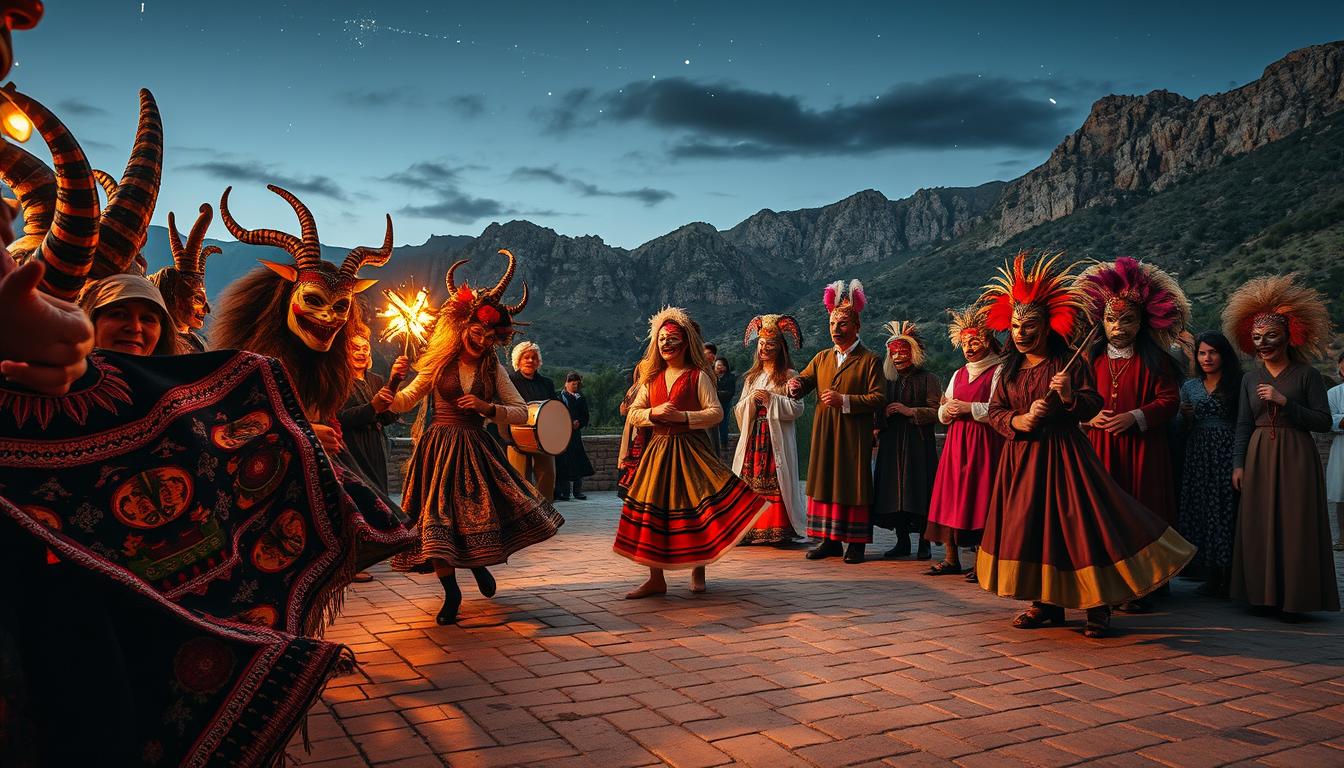
Beyond the famous landmarks of Rome and Venice lies a deeper cultural current. I first encountered it not in a guidebook, but by chance in a Sardinian hilltop village. The air thrummed with the sound of bells and rhythmic footsteps. This was a living, breathing ceremony, one of Italy’s hidden traditions.
These festivals are not performances for tourists. They are ancient rites tied to the land and seasons. Rooted in pre-Christian times, they tell stories of fertility, life, and death. The masked figures, often adorned with wood and sheepskin, are powerful symbols. They represent a dialogue between chaos and order that has echoed for centuries.
For the traveler seeking authentic connection, these events are a treasure. They offer a rare glimpse into a world where community and culture are inseparable. It is a profound experience that stays with you long after you return home.
Key Takeaways
- Sardinian mask festivals are ancient, community-based events distinct from mainstream tourist attractions.
- These celebrations are deeply connected to agricultural cycles and mythological narratives.
- The masks are handcrafted artifacts rich with symbolic meaning.
- The festivals provide a genuine form of cultural immersion for discerning travelers.
- They represent a resilient preservation of local heritage in a globalized world.
Introduction to Sardinian Mask Festivals
What first struck me about Sardinia was how its interior villages maintain ceremonial practices untouched by mainstream tourism. The island occupies a unique position within the broader cultural landscape, preserving traditions that diverge significantly from mainland customs. This distinctiveness stems from geographical isolation and a complex historical trajectory.
These mask celebrations represent some of Europe’s most archaic ceremonial practices. They are enacted by and for local communities, with participation often restricted to families who have inherited specific roles across generations. The festivals create an authenticity that commercial events cannot replicate.
The significance of these rituals extends far beyond the Catholic calendar into pre-Christian agricultural traditions. Understanding them requires approaching them as living anthropological phenomena. They continue to fulfill social and spiritual functions within village life.
Each community maintains its own distinctive mask characters and ritual sequences. This creates rich diversity across the island that rewards extended exploration. The atmosphere transforms familiar streets into stages connecting participants with ancestral memory.
Historical Origins of Sardinian Mask Traditions
Standing before a masked figure, I felt the weight of centuries, a direct link to practices that predate modern civilization. The true history of these ceremonies is a puzzle scholars are still piecing together. Their roots likely extend into the Neolithic and Bronze Age.
Archaeological sites, like the enigmatic nuraghi towers, suggest ancient peoples used disguise in rituals. The masks often feature animal traits—bulls, sheep, deer. This points to a deep, symbolic connection to the natural world.
Ancient Rituals and Myths Behind the Masks
These were not mere costumes. They were vital tools for survival. Farmers and herders used them in sympathetic magic. The goal was to ensure fertile land and healthy flocks. This was a critical part of life for many cultures across vast stretches of time.
Influences of Roman and Medieval Practices
Later, new layers were added. Roman festivals, like Saturnalia, introduced ideas of social reversal. When Christianity spread, the church could not erase these deep-seated traditions. Instead, it folded them into the calendar before Lent. The core pagan spirit endured, proving its power over thousands of years.
Cultural Significance of Mask Festivals in Sardinia
The moment I witnessed my first Sardinian mask festival, I understood these were not mere performances but living embodiments of cultural identity. They function as essential mechanisms for social cohesion, binding communities through shared participation.
These celebrations represent a profound way of maintaining collective memory. Each ritual reinforces the values that define local life across generations.
Symbolism and Local Beliefs in Mask Imagery
The masks operate on multiple symbolic levels simultaneously. They mediate between agricultural cycles and metaphysical realms, ensuring protection and abundance.
Specific characters embody archetypal forces. The Mamuthones, weighted with cowbells, represent winter’s burden or ancestral spirits. Their solemn procession creates a powerful visual narrative.
For participants, donning a mask becomes a transformative experience. Individual identity subsides as the wearer channels collective memory. This temporary transformation serves both psychological and social functions within the community.
These festivals distinguish Sardinian people through unique cultural expressions. The pride in local variations preserves authentic tradition against commercialization. This living culture continues to shape community identity through powerful symbolic traditions.
Community and Family Traditions in Sardinian Celebrations
The true heartbeat of these festivals pulsed not in the public square, but within the intimate spaces of family homes. I observed how participation follows bloodlines, with specific roles inherited like precious heirlooms.
Preparation begins months in advance. In quiet workshops and living rooms, elders teach younger members the precise movements and behavioral codes. This intergenerational exchange is the ceremony’s foundation.
Women maintain crucial though often unseen roles. Their hands craft costumes and prepare traditional foods that sustain the celebrations. Their labor embodies a different way of preserving culture.
“We do not perform these rituals—we live them through our ancestors’ hands.”
The festivals call people back home from distant cities and countries. They reinforce bonds that modernization might otherwise weaken. This gathering of diaspora members strengthens collective identity.
| Family Role | Primary Responsibility | Knowledge Transmission |
|---|---|---|
| Elders | Preserve ritual details | Oral instruction & demonstration |
| Middle Generation | Costume maintenance | Hands-on mentoring |
| Youth | Learn movements | Observation & practice |
This domestic dedication creates authentic experiences that stand apart from commercialized events. For those seeking deeper connections, discovering Italy’s traditional festivals offers unparalleled insight into living heritage.
Traditional Rituals and Festive Performances
I learned that the true power of these rituals lies not in their spectacle, but in their meticulously structured sequence of movements. On a festival day, the entire community fills the streets. Elders and children alike become part of a living tapestry.
This is not a random gathering. It is a carefully choreographed event passed down through generations.
Processions, Parades, and Dance
The procession is the festival’s backbone. Masked figures follow routes that trace ancient boundaries. They transform ordinary streets into sacred pathways.
Movement is deeply symbolic. The Mamuthones advance in slow, synchronized rows. Their heavy cowbells create a hypnotic soundscape.
What an outsider might call dance is actually ritualized motion. Stamping feet awaken the earth. Circular patterns honor cyclical time.
These acts can be unsettling. They incorporate mock chases and symbolic captures. Within the ritual, these transgressive acts serve a vital, cathartic purpose.
| Ritual Element | Symbolic Meaning | Community Role |
|---|---|---|
| Processional Route | Maps ancient spiritual areas | Reinforces collective memory |
| Synchronized Movement | Represents social order | Requires intergenerational practice |
| Ritualized Sound | Shifts consciousness | Creates an immersive environment |
The entire experience is a profound demonstration of living tradition. It connects participants and observers to a deep, cultural current.
Exploring Italy’s Hidden Traditions
What became clear to me was that Italy’s cultural richness lies in the subtle variations between neighboring towns, each preserving distinct customs. This remarkable diversity extends far beyond the Sardinian mask festivals I witnessed. The entire country functions as a living museum of regional expressions.
Throughout the peninsula, countless local celebrations survive in villages and smaller cities. These practices persist as vital community rituals rather than nostalgic recreations. Their authenticity stems from deep local participation.
Geographical barriers and historical political fragmentation have paradoxically preserved this cultural wealth. Mountain ranges and centuries of separate governance created unique identities across different regions. This contrasts with more standardized nations.
| Cultural Experience | Typical Location | Level of Authenticity |
|---|---|---|
| Mask Festivals | Inland villages | High – community-based |
| Artisan Workshops | Small towns | Medium – some commercialization |
| Seasonal Celebrations | Rural areas | High – tied to local cycles |
Exploring these hidden traditions requires a different approach to travel. Specialized tours that emphasize extended stays in single regions offer the most rewarding access. They prioritize genuine cultural exchange over superficial consumption.
The Sardinian festivals provide an ideal entry point for this deeper exploration. Their relative obscurity preserves authentic encounters. They reveal the complex realities underlying Italy’s popular image.
Artistry Behind Handcrafted Sardinian Masks
Observing a master carver at work revealed the profound connection between material and meaning. The creation of these masks represents a specialized craft that demands both technical skill and cultural understanding.
Masks are typically carved by hand from local woods like pear or willow. The techniques have remained essentially unchanged for many years, with each artisan developing a distinctive style within traditional forms.
Techniques and Regional Styles in Mask Making
The carving process itself carries ritualistic dimensions. Some artisans observe specific protocols regarding wood harvesting and seasoning. This attention to detail makes each mask a unique part of the cultural tapestry.
Regional variations reflect local mythologies and aesthetic preferences. The darkened visages of Mamoiada contrast sharply with Ottana’s naturalistic animal masks. Each community maintains distinct iconographies that tell their specific stories.
The Role of Local Artisans and Craftsmanship
Traditional mask makers occupy respected positions within their communities. Their work is recognized as essential to cultural continuity, though this rarely translates into substantial economic compensation.
The contemporary challenge involves balancing preservation against market pressures. Museums around the world now collect these masks, but their removal from ritual context transforms them. For the artisans working today, maintaining authenticity remains the primary concern.
Sardinian Festival Attire and Fashion
The visual impact of a Sardinian mask festival is inseparable from the powerful, textured beauty of the traditional costumes. These garments represent an aesthetic universe distinct from the contemporary styles of mainland cities. They speak a language of symbolism and heritage.
Each village maintains its own sartorial identity. Color palettes, weaving patterns, and accessory combinations act as a map, identifying the wearer’s origins. This is one of the most visible ways communities preserve their unique character.
Dressing the Part: Traditional Outfits and Accessories
Men’s costumes are formidable constructions. Heavy wool, leather, and entire sheepskins create a powerful, almost otherworldly silhouette. The addition of cowbells transforms the wearer into a walking, sounding manifestation of ritual.
Women’s attire, though not part of the masked performance, displays equal artistry. Intricate hand-embroidery and layered fabrics reflect both status and sophisticated local craft. The beauty here is in the meticulous detail.
Dressing is a transformative act. Each garment facilitates a psychological shift from individual to ritual participant. This deep connection makes authentic preservation a vital concern for communities honoring these living traditions.
The Intersection of Music, Dance, and Storytelling
The sound that first captured my attention was not the visual spectacle of the masks, but the deep, resonant polyphony of male voices rising from the village square. This ancient vocal form, canto a tenore, provides the essential sonic landscape for the entire ritual. It is the heart of the festival’s atmosphere.
Traditional instruments like the launeddas, a triple-pipe reed instrument, produce sounds that connect the celebration directly to pre-Roman antiquity. The relationship between music and masked performance is integral, not merely accompaniment. Rhythmic structures directly dictate the movements and emotional states of the performers.
Traditional Instruments and Folk Narratives
Folk narratives provide the mythological foundation for the characters we see. Stories of ancestral spirits and liminal creatures find their embodiment through these costumed performances. This is a profound way of keeping culture alive.
Elders preserve the deeper meanings through oral storytelling. This ensures that the rituals retain their significance for younger generations, even as their connection to the original agricultural life changes. The intersection of these elements creates a powerful, multisensory experience.
| Element | Role in Festival | Cultural Significance |
|---|---|---|
| Canto a Tenore | Creates emotional & ritual atmosphere | Ancient vocal harmony, UNESCO recognized |
| Launeddas | Provides rhythmic & melodic foundation | Direct link to Nuragic civilization |
| Folk Narratives | Provides character backstory & meaning | Oral history preserving local identity |
For communities today, this fusion is not a performance but a lived reality. It is a continuous thread connecting the present to a deep, resonant past.
Culinary Delights and Local Wine at Mask Festivals
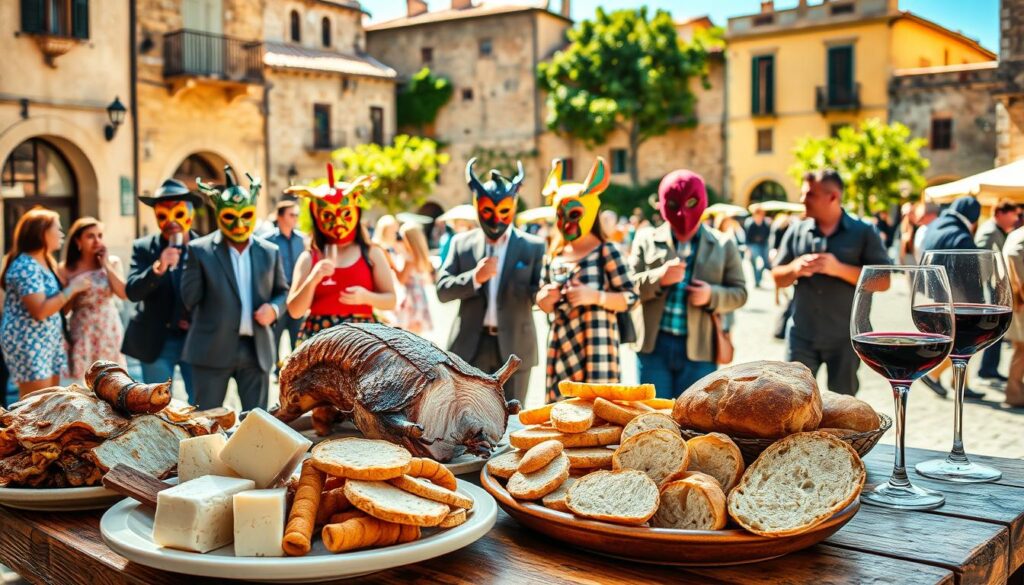
What struck me most about the festival’s communal aspect was how every ritual moment found its counterpart in shared meals and traditional dishes prepared with generations of care. The preparation of festival food involves collective labor that reinforces social bonds as families collaborate to sustain multi-day celebrations.
Authentic Sardinian Recipes and Special Dishes
Signature festival dishes reflect the island’s pastoral heritage. Porceddu, a spit-roasted suckling pig, fills the air with its distinctive aroma. Culurgiones, a unique stuffed pasta, showcases regional culinary artistry.
Traditional flatbread and cheese-filled pastries complete the feast. These dishes carry symbolic meanings related to fertility and abundance. Each recipe represents generations of refinement.
Signature Regional Wines and Food Pairings
Sardinian wines from indigenous grapes accompany festival meals beautifully. Cannonau and Vermentino offer distinctive terroir expressions. Wine serves as both social lubricant and ritual substance.
The experience transcends mere gustatory pleasure. It provides access to cultural meanings embedded in culinary practices. Proper respect for these traditions enhances the encounter.
Language, Dialects, and Cultural Expressions in Sardinia
The linguistic landscape of Sardinia revealed itself to me not through textbooks, but through the whispered conversations and ritual chants that accompanied the mask festivals. I quickly understood that the island’s language represents a distinct cultural universe, separate from mainland expressions.
Exploring Sardinian Dialects and Local Expressions
Sardinian is not merely a regional variation but a fully developed Romance language with ancient roots. Its grammatical structures preserve Latin features lost in modern Italian language. This creates one of Europe’s most archaic linguistic treasures.
Within the island, significant variation exists among major dialects like Logudorese and Campidanese. Each village maintains subtle linguistic distinctions that reflect local identity. These micro-variations represent living connections to specific cultural histories.
The ceremonial use of Sardinian during mask festivals serves multiple functions. It maintains authenticity while preserving specialized vocabulary for traditional practices. This creates meaningful ways of safeguarding cultural knowledge that resists translation.
For visitors, recognizing this linguistic diversity demonstrates respect for cultural complexity. Even basic engagement with local dialects reveals Sardinia’s rich heritage beyond standardized Italian.
Preservation of Traditional Crafts and Mask-Making Techniques
The quiet determination I witnessed in village workshops spoke volumes about the delicate balance between preserving heritage and adapting to modern realities. These artisans work with a profound understanding that their craft represents more than artistic skill—it’s the living embodiment of community identity.
Today, traditional mask-making faces complex challenges. Economic pressures make sustained artisan work difficult, while younger generations often seek opportunities beyond their ancestral home. The transmission of specialized knowledge becomes increasingly fragile.
Sustainable Practices and Heritage Conservation
Sustainable preservation requires more than museum displays. It demands that traditions maintain their functional significance within living communities. Various initiatives now support this delicate ecosystem.
Cultural associations and regional programs help practitioners continue their work. UNESCO recognition provides important validation. Yet the greatest challenge lies in supporting tradition without commercial distortion.
Some communities have developed thoughtful models. They allow selective visitor access while prioritizing local participation. This creates economic benefits without compromising authenticity.
The most effective strategies recognize that traditions survive when they fulfill meaningful roles. Supporting overall community vitality—economic opportunity, social cohesion—proves more important than targeting isolated practices.
Differences Between Sardinian Mask Festivals and Other Italian Celebrations
Comparing Sardinian rituals with other Italian festivities reveals fundamental differences in purpose, participation, and preservation. The mainland’s famous Carnival events have transformed into spectacular public displays, while Sardinia’s ceremonies remain intimate community rites.
This divergence stems from historical isolation and distinct cultural development across various Italian regions. Each area developed unique expressions reflecting local environments and social structures.
Unique Regional Customs and Celebratory Styles
Sardinian masks evoke primal forces rather than carnival whimsy. They connect to ancient agricultural cycles, unlike mainland celebrations that often serve civic or tourist functions.
The entire country displays remarkable cultural diversity. Just as pasta shapes and pizza styles vary dramatically between regions, so do festival forms reflect local identities.
| Feature | Sardinian Festivals | Mainland Celebrations |
|---|---|---|
| Primary Focus | Community ritual & ancestral connection | Public spectacle & tourism |
| Participant Role | Fluid boundaries between performers and community | Clear separation between actors and audience |
| Symbolic Content | Pre-Christian agricultural themes | Christian or secular civic themes |
| Cultural Preservation | Minimal modification due to isolation | Significant adaptation to modern contexts |
Understanding these distinctions requires appreciating Italy’s regional cultures as distinct entities. Sardinia’s festivals offer unparalleled access to living traditions that have resisted homogenization.
Impact of Modern Trends on Sardinian Festival Traditions
The glow of smartphone screens now mingles with torchlight during ancient processions, creating a visual metaphor for the complex relationship between tradition and modernity. Communities face unprecedented pressures from globalization and digital connectivity.
Social media brings visibility to once-private ceremonies. This generates support but risks turning sacred rituals into performances for external audiences. Younger generations educated in standard languages may view festivals as heritage rather than living practice.
Balancing Innovation with Time-Honored Practices
Some villages embrace selective modernization while protecting ritual cores. They demonstrate that adaptation need not threaten authenticity. Tourism presents both opportunity and threat—revenue supports artisans but tourist expectations can pressure simplification.
Environmental changes and rural depopulation affect the material basis of traditions. The question of who controls cultural heritage becomes increasingly contested as external interest grows.
| Modern Challenge | Community Response | Impact on Tradition |
|---|---|---|
| Digital Documentation | Controlled access protocols | Increased visibility with authenticity risks |
| Youth Engagement | Intergenerational mentoring programs | Preserved knowledge with contemporary relevance |
| Tourist Expectations | Selective visitor accommodation | Economic support without ritual compromise |
Despite these challenges, communities show remarkable resilience. Traditions survive through selective evolution that maintains connection to foundational values. This delicate balance continues to shape ceremonies across the island.
Tips for Experiencing Sardinian Mask Festivals Firsthand
Planning your journey to witness these profound ceremonies requires thoughtful preparation beyond typical vacation logistics. The most rewarding encounters demand both practical foresight and cultural sensitivity.
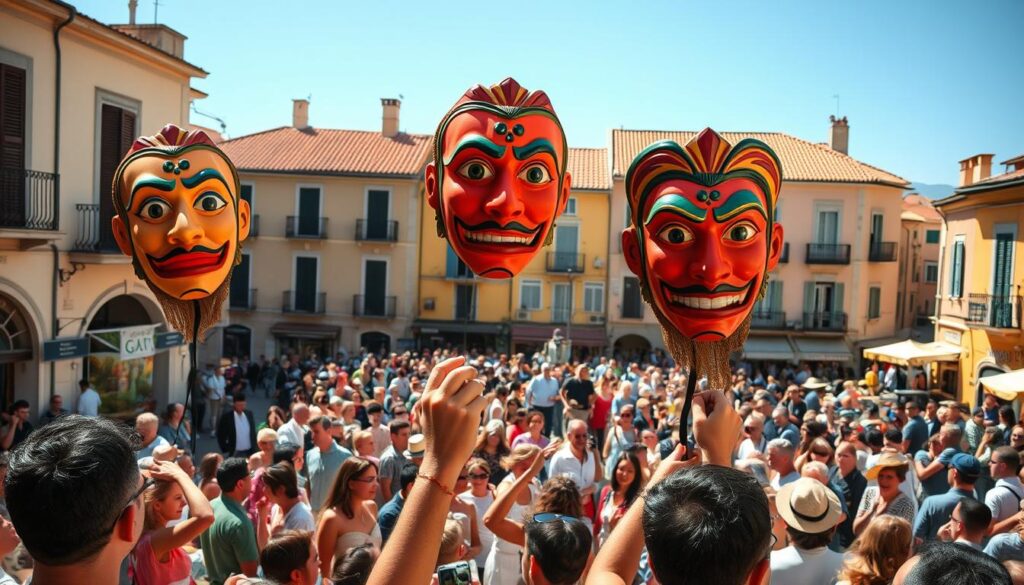
Timing is everything for this unique travel experience. Major celebrations cluster during Carnival season from January through March. However, dates vary annually by village. Research specific communities like Mamoiada or Ottana well before your trip.
Best Times to Visit and Essential Local Etiquette
Authentic encounters happen in interior villages rather than coastal centers. These communities maintain ceremonies with deep local participation. Approach as a respectful observer, not an entitled consumer.
Practical considerations prove crucial. Secure accommodation months ahead in small villages with limited options. Arrange transportation early since public transit is sparse. Prepare for potentially harsh winter conditions in mountainous areas.
Cultural respect begins with language. Learning basic Italian phrases demonstrates consideration. A few Sardinian words can open doors to warmer receptions. Remember that complete understanding may remain elusive—embrace the mystery.
| Village Experience | Best Preparation | Cultural Consideration |
|---|---|---|
| Mamoiada | Book winter lodging early | Photography restrictions during rituals |
| Ottana | Private transport essential | Observe from periphery, don’t interrupt |
| Oristano | Flexible dates for shifting schedules | Engage local guides for deeper access |
Even daily routines like coffee drinking carry significance. Coffee is consumed quickly as an energizer, not lingered over. Understanding these subtle customs helps visitors blend more naturally into the local rhythm.
Extending your stay beyond the festival day transforms a spectacle into true immersion. Visit artisans, taste traditional foods, and engage with daily life. This approach honors the complexity of living cultural traditions.
Conclusion
The experience left me with a conviction that true cultural wealth lies not in monuments, but in living practices that continue to breathe meaning into daily life. These festivals remain at the heart of community identity precisely because they fulfill essential human needs for connection.
For travelers seeking genuine encounters, a festival day offers transformative insight into how local people maintain their heritage. The shared meals of traditional food and local wine create bonds that transcend typical tourism.
Sardinia stands as one of Europe’s most culturally distinct regions, where ancient practices thrive far from any major city. The invitation extends beyond this island to approach all travel with respect for the delicate beauty of living traditions.