

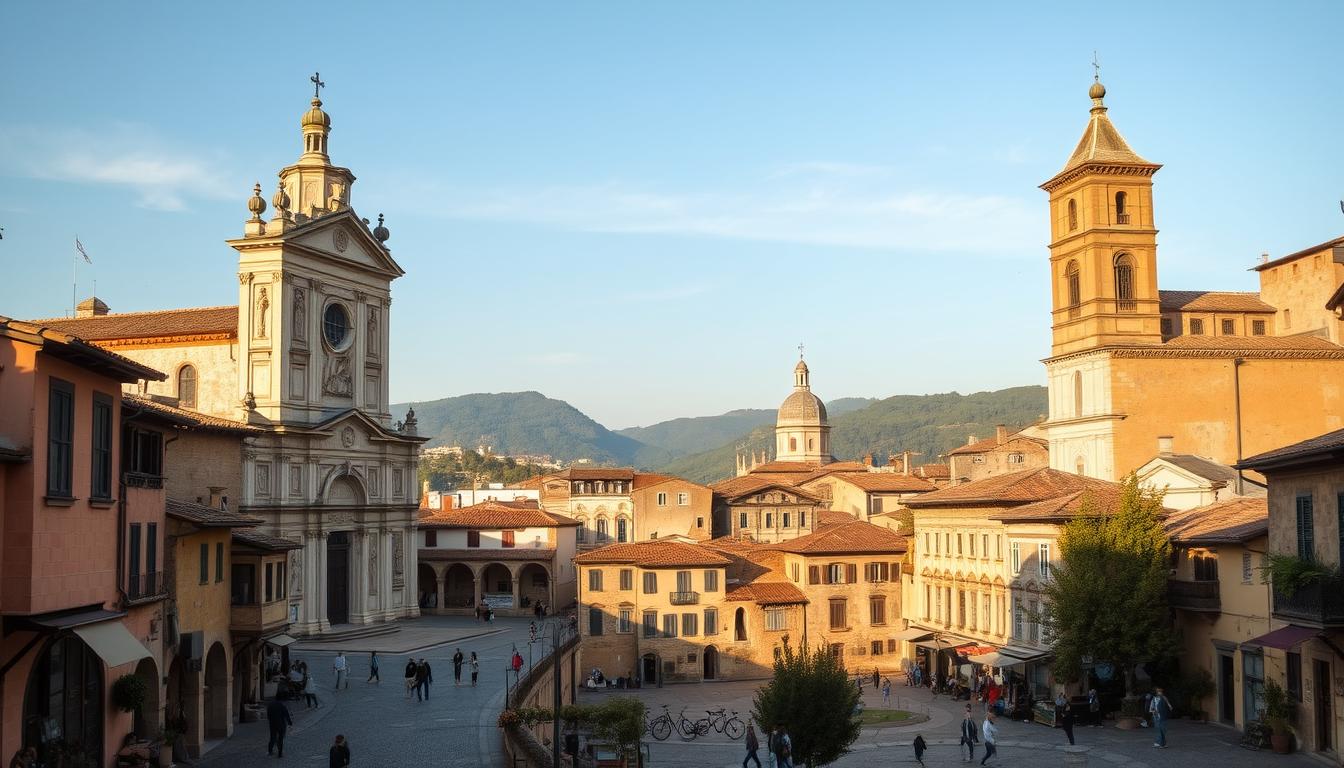
I first discovered Fermo when I deliberately stepped away from the well-worn paths of Florence and Rome. I was searching for something more meaningful than the predictable rhythms of mass tourism. This remarkable place immediately revealed itself as one of those special destinations where culture breathes through every stone and silence.
Nestled in the Marche region between the Adriatic coast and Apennine foothills, Fermo stands as an understated capital of Renaissance achievement. The accumulated beauty of centuries remains accessible here for those willing to venture beyond the obvious. The town’s historical significance extends from Roman foundations through medieval prosperity to its artistic flowering.
What distinguishes Fermo within Italy’s cultural landscape is its layered authenticity. The absence of performative tourism allows local life to exist for itself rather than for external consumption. My exploration became a gateway to understanding how such places function as living museums. The past informs the present without being reduced to spectacle.
Key Takeaways
- Fermo offers a sophisticated alternative to crowded tourist destinations
- The town maintains an authentic connection between art, history, and community
- Renaissance treasures remain accessible in a quiet, contemplative setting
- Geography and history converged to create this cultural center
- Fermo represents the genuine experience of Italy’s lesser-known destinations
- The town provides luxury through contemplation and genuine discovery
Discovering the Hidden Renaissance Gem of Fermo
What drew me to Fermo was the promise of discovering a place where Renaissance culture flourished without the glare of international fame. This town’s layered history reveals itself gradually to those willing to look beyond surface appearances.
Historical Overview and Cultural Legacy
Fermo’s heritage stretches back to pre-Roman times, with each successive era leaving distinctive marks on its urban fabric. During the Renaissance, it emerged as a significant ecclesiastical center within the Marche region, attracting thinkers and creators who contributed to its artistic legacy.
The cultural synthesis I encountered reflects a distinctive Renaissance character—more intimate than Florentine grandeur yet equally sophisticated. Fermo operated at a crossroads where diverse influences converged, creating something uniquely compelling.
Why Fermo Stands Out in the Marche Region
What distinguishes Fermo is its preservation of authentic urban rhythms. Unlike more famous destinations, it retains the functional complexity of a living community where visitors encounter daily life rather than curated exhibitions.
| Feature | Fermo | Urbino (UNESCO Site) |
|---|---|---|
| Cultural Preservation | Living, integrated heritage | Museum-focused presentation |
| Visitor Experience | Authentic daily encounters | Structured tourist pathways |
| Historical Context | Continuous urban evolution | Period-specific restoration |
The true value of provincial Renaissance centers lies in their ability to maintain cultural integrity outside competitive artistic capitals.
Fermo’s relative obscurity has paradoxically preserved its cultural authenticity. The absence of mass tourism allows the heritage to exist in meaningful context, rewarding sustained attention rather than quick consumption.
Exploring Fermo’s Architectural Treasures
The architectural narrative of Fermo unfolds gradually, revealing a sophisticated dialogue between medieval foundations and Renaissance refinement. Unlike towns preserved as museum pieces, Fermo’s buildings function within a living urban context.
Medieval Structures and Stone Walls
Fermo’s medieval architecture establishes the city’s fundamental character. The enduring stone walls that partially encircle the historic center demonstrate remarkable engineering. These structures employ local materials that have maintained integrity for centuries.
The medieval streets themselves create dramatic perspectives. Their narrow passages frame controlled views that Renaissance builders understood and enhanced. This creates an urban experience where every turn reveals new architectural relationships.
Renaissance Details in Local Buildings
Renaissance influences appear as refined additions rather than complete transformations. I observed elegant doorways and proportioned windows enhancing existing medieval buildings. This adaptive approach respects the original architecture while introducing humanistic values.
The local stone connects Fermo’s buildings to the surrounding landscape. Subtle color variations shift with sunlight, creating visual harmony between constructed and natural environments. This material continuity gives the city its distinctive character.
| Architectural Element | Fermo’s Approach | Typical Renaissance Treatment |
|---|---|---|
| Medieval Foundations | Adaptive reuse with Renaissance details | Often complete reconstruction |
| Street Layout | Preserved medieval narrowness | Frequently widened and regularized |
| Building Materials | Local stone maintained throughout | Often new materials introduced |
Fermo’s architectural treasures demonstrate how different eras can coexist harmoniously. The city’s streets and walls tell a continuous story of cultural evolution rather than periodic reinvention.
Secret Italian Art Towns: A Traveler’s Guide
Beyond the famous urban centers lies a different Italy, one where masterpieces reside in quiet provincial settings. My journey through this landscape revealed how cultural discovery flourishes when freed from crowded museums.
Key Destinations in Central Italy
The experience of finding significant works in unexpected places transforms travel into personal discovery. Towns like Arezzo and Urbino demonstrate that provincial centers often rival major cities in artistic importance.
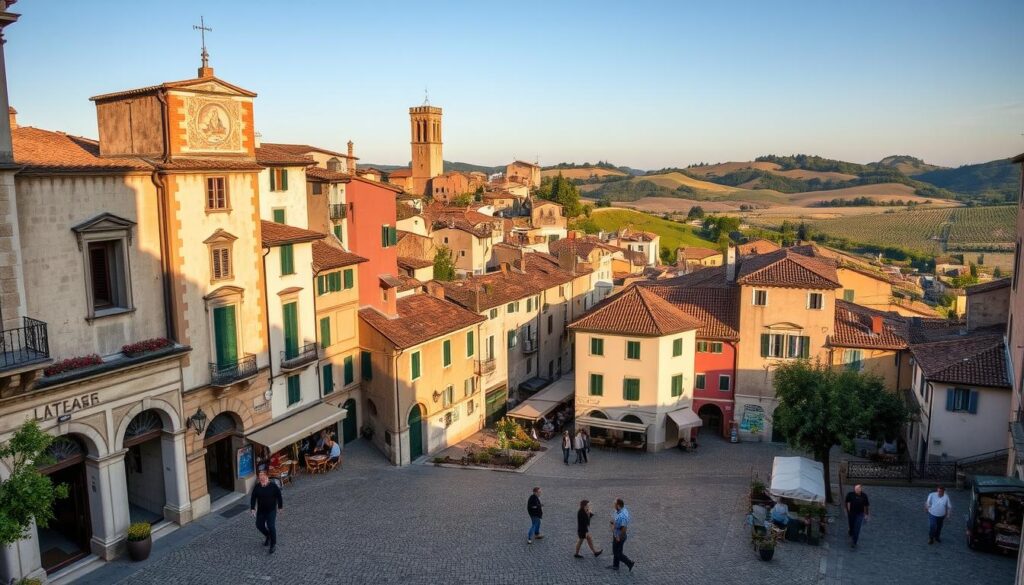
What distinguishes these destinations is not just their heritage but the quality of encounter they offer. The absence of crowds creates space for genuine contemplation.
Fermo serves as an ideal base for exploring this network of cultural treasures. The journey between these towns becomes as meaningful as the destinations themselves.
This approach to travel values depth over breadth, inviting visitors to explore hidden gems of Italy where art exists within living communities rather than sterile exhibition spaces.
Medieval Architecture and Intricate Stonework in Fermo
Exploring Fermo’s streets felt like reading a historical text written in stone, where each building tells a story of medieval ingenuity. The town’s medieval architecture reveals itself through careful observation rather than dramatic presentation.
I spent hours examining the intricate stonework around doorways and windows. Medieval masons demonstrated remarkable skill through decorative elements that served both structural and aesthetic purposes.
The defensive walls that once protected Fermo now function as historical documents. Their construction techniques show how builders adapted Roman foundations to meet evolving needs.
What distinguishes Fermo’s architecture is its evolutionary character. Unlike towns restored to uniform historical appearance, Fermo retains evidence of continuous adaptation.
The true beauty of this medieval architecture lies in the cumulative effect of consistent craftsmanship. Watching how local stone responds to changing light reveals dimensions that photography cannot capture.
These ancient walls and structures achieve harmony through empirical refinement. The architecture embodies a material intelligence where necessity and aspiration become inseparable.
This creates an urban fabric of remarkable beauty—one that rewards sustained observation and reveals its secrets gradually to patient visitors.
Local Culinary Delights and Wine Experiences
The true essence of Fermo reveals itself not just through its architecture but through the sensory experiences of its culinary traditions. Here, the region’s geographical duality between mountains and sea creates a remarkable gastronomic complexity.
Authentic Italian Dishes and Regional Wines
I found that Fermo’s food traditions maintain an authenticity often lost in more touristed destinations. Restaurants prioritize seasonal availability and traditional methods, cooking primarily for local clientele.
The local wine, particularly Rosso Piceno and Pecorino varieties, demonstrates how terroir expresses itself through viticulture. Tasting these while overlooking the landscapes that produced them creates a profound sensory connection.
My most memorable culinary experience involved simple preparations where superior ingredients spoke for themselves. This aristocracy of simplicity characterizes the best of local cuisine.
Cafés, Artisan Shops, and Food Festivals
The artisan shops scattered throughout Fermo’s historic center offer products representing genuine craft. I discovered aged cheeses from mountain shepherds and cured meats following centuries-old recipes.
Fermo’s café culture provides spaces for observing daily life while experiencing the ritual of coffee. These establishments function as social institutions where espresso quality and convivial atmosphere matter equally.
Throughout the year, food festivals transform public spaces into vibrant celebrations. These events reveal how cuisine functions as cultural expression rather than mere sustenance.
The artisan shops and festival atmosphere create a living tapestry of traditions. Each glass of wine becomes part of Fermo’s ongoing story.
Artistic Heritage: Churches, Frescoes, and Masterpieces
Entering Fermo’s churches felt like stepping into galleries where spiritual purpose and aesthetic achievement remain inseparable. Unlike museum presentations that isolate objects, these spaces maintain the original integration of art and worship.
Historic Churches and Religious Art
The Church of San Francesco demonstrates how religious orders commissioned works balancing devotion with sophistication. I found layered environments where medieval, Renaissance, and Baroque elements coexist.
Santa Maria preserves local traditions that formed the foundation for greater achievements. These vernacular works reveal the cultural milieu that enabled Renaissance breakthroughs.
Masterpieces by Renaissance Pioneers
While Fermo lacks works by Piero della Francesca comparable to his Arezzo frescoes, his influence permeates central Italian art. Understanding his perspective innovations enhances appreciation of local masterpieces.
The frescoes here document evolving techniques across centuries. They show how quality distributed throughout Italy rather than concentrating in major centers.
Experiencing these works in liturgical context provides dimensions unavailable in museums. The spaces engage multiple senses and invite contemplation, continuing their original purpose of elevating consciousness through beauty.
Historic Streets and Narrow Alleys: Discovering Fermo’s Charm
The moment I stepped into Fermo’s network of historic streets, the modern world receded. These passages, worn smooth by centuries of footsteps, immediately established a different rhythm of movement and perception.
What struck me most was how these narrow streets function as living architecture. They’re not merely routes between points but social spaces where daily life unfolds in plain view. Neighbors chat across alleys, their voices creating an intimate soundscape unique to these confined spaces.
The charm of Fermo’s narrow alleys lies in their human scale. Unlike the grand boulevards of famous towns, these passages create a sense of enclosure that feels protective rather than restrictive. Each turn reveals new perspectives on the historic town‘s layered architecture.
I discovered that getting pleasantly lost is part of the experience. The irregular pattern of these streets follows medieval logic rather than modern planning. This organic layout creates constant discovery moments where Renaissance doorways suddenly appear between ordinary buildings.
The true charm emerges from authentic complexity—laundry hanging between buildings, small workshops operating behind ancient doorways. Unlike preserved museum towns, Fermo’s alleys maintain functional vitality that makes the art of daily living visible to observant visitors.
Vibrant Atmosphere: Festivals and Local Life
The distinction of Fermo became clearest to me during a local festival, where the town’s historic spaces were animated by a genuine, community-driven atmosphere. This was not a spectacle staged for outsiders but a celebration deeply woven into the social fabric. The experience felt like being granted temporary membership in a private club whose rituals spanned generations.
Cultural Events and Traditional Celebrations
Fermo’s calendar is punctuated by events that reveal its living culture. Unlike the famous Palio of Siena, these gatherings possess a modest scale that fosters intimacy. I observed families, elders, and children participating in roles that clearly held personal significance, not just performative value.
This authentic atmosphere allows visitors to engage with local life on its own terms. The shared joy of a food festival or a historical reenactment creates a bridge, however temporary, between resident and guest.
Yet the most profound cultural experience often lies in Fermo’s daily rhythms. The town possesses a constant, low-key festivity.
- The evening passeggiata, when the main street fills with strolling families.
- The animated Saturday market, a weekly ritual of commerce and conversation.
- The quiet gatherings in cafés after Sunday Mass.
For visitors, understanding this seamless blend of celebration and daily life is key to appreciating Fermo’s unique character. It is a place where tradition breathes naturally, not artificially.
The Influence of Piero della Francesca and the Renaissance Legacy
My appreciation for Fermo’s cultural landscape deepened when I considered the intellectual currents that shaped the Renaissance. Understanding the figures who defined this era provides a richer context for the masterpieces encountered here.
Artistic Innovations and Timeless Masterworks
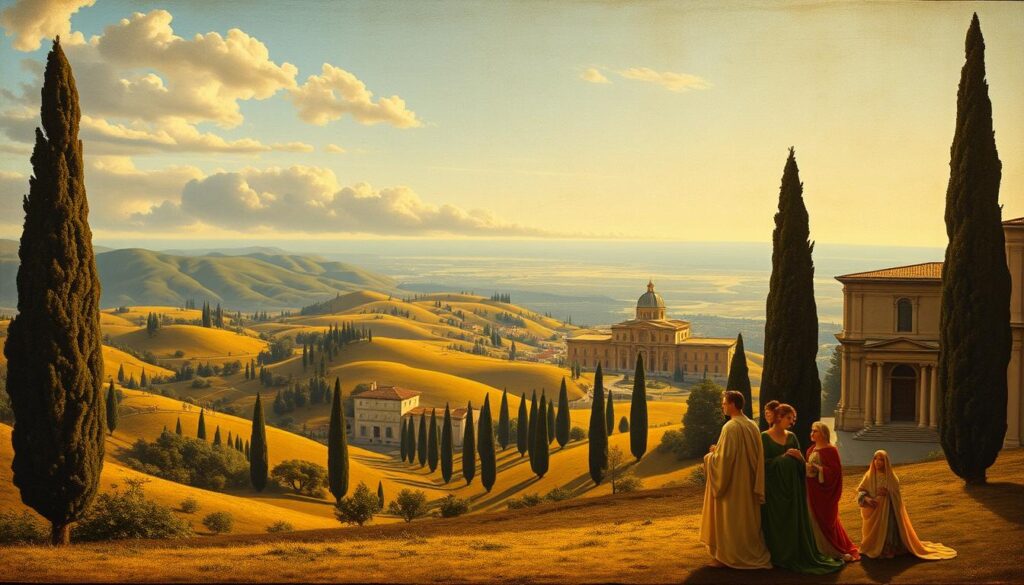
Piero della Francesca, born in Sansepolcro around 1412, was both an artist and a mathematician. His work represents a pivotal moment in art history, where painting embraced scientific principles.
He applied geometry to create compositions of profound spatial clarity. His serene, light-filled scenes feel both mathematically precise and spiritually elevated.
Seeing his fresco cycle, The Legend of the True Cross, in Arezzo was a revelation. It is a masterpiece of perspective that rewards patient, booked viewing.
Piero’s legacy is a philosophical approach where rational structure and spiritual content achieve perfect balance.
This influence permeated central Italy, affecting even provincial centers like Fermo. Local artists absorbed his methods for spatial construction.
The heritage of the Renaissance is this fusion of observation and ideal order. Piero’s work remains compelling because it addresses how art represents both physical reality and transcendent meaning.
His contribution to the history of painting extends far beyond his immediate world. It established principles that continue to resonate.
Other Must-See Italian Art Towns for a Curated Journey
Curating a journey through Italy’s provincial art centers requires balancing well-known destinations with more intimate discoveries. This approach transforms travel from checklist tourism to meaningful cultural immersion.
Highlights from Tuscany and Beyond
San Gimignano’s medieval skyline creates an unforgettable silhouette against the Tuscan hills. The Piazza della Cisterna serves as the social heart where visitors can enjoy a glass of local wine while absorbing architectural grandeur.
Arezzo’s Piazza Grande offers one of Italy’s most beautiful urban spaces. Its irregular geometry creates visual richness impossible in rigidly planned squares.
The surrounding landscapes of olive groves and vineyard-covered slopes form integral parts of the aesthetic experience. These views connect human settlement with natural environment.
Unique Gem Destinations Off the Beaten Path
Beyond Tuscany, destinations like Urbino and Spoleto offer cultural treasures while receiving fewer visitors. These places reward travelers with encounters that feel like personal discoveries.
The charm of lesser-known towns lies in their continued authenticity. They function primarily as communities rather than tourist attractions.
Each destination offers distinctive character shaped by specific history and geography. Understanding these particularities transforms a multi-town journey into nuanced exploration.
The true beauty these places offer is not merely visual but philosophical. They embody principles of proportion and human-scaled urbanism that contemporary cities have largely abandoned.
Conclusion
Fermo’s greatest lesson for the thoughtful traveler is that true discovery requires surrendering preconceptions and embracing local realities. This remarkable town demonstrates how cultural heritage can flourish when integrated with contemporary life rather than preserved as spectacle.
My journey through the Marche region revealed that the most profound experience often occurs away from crowded destinations. The panoramic views from Fermo’s hills offer more than scenic beauty—they provide perspective on how art and history can shape a living community.
The authentic atmosphere here reminds visitors that meaningful travel involves entering another world on its own terms. Fermo’s enduring culture challenges us to reconsider what we value in our own communities.