

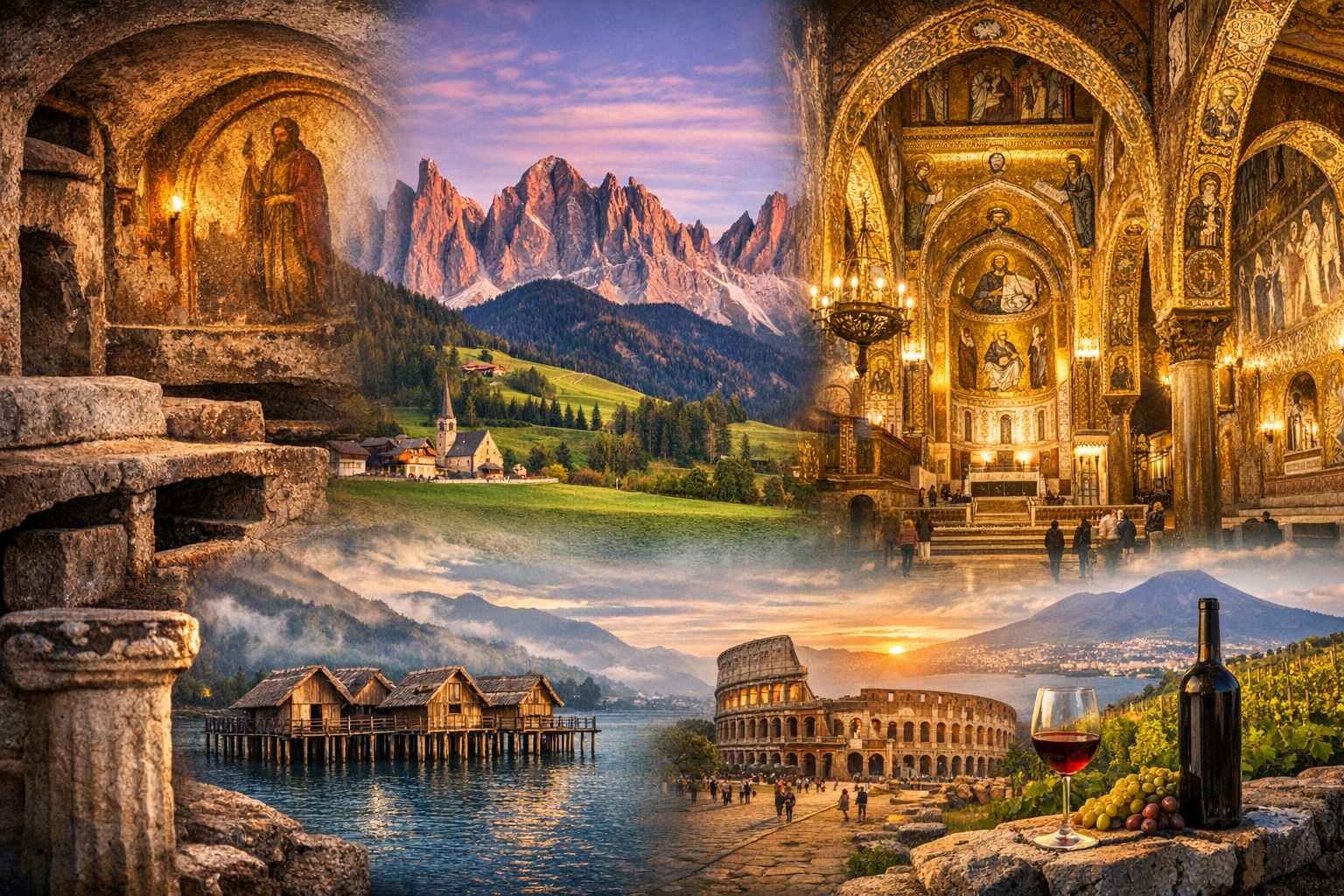
For every monument that stands above ground in Rome, there are estimated to be dozens more buried beneath the city’s streets, piazzas, and apartment blocks.
Rome has been continuously inhabited for nearly three thousand years, and each era built directly on top of the last. The result is a vertical archaeology of civilization that descends more than fifteen meters below the modern street level in some areas.
The most famous underground Rome is the Catacombs — the vast networks of tunnels used by early Christian communities for burial between the second and fifth centuries AD. Over 60 catacomb complexes have been identified beneath the city, collectively containing the remains of hundreds of thousands of people and stretching for hundreds of kilometers of tunnels. Only a handful are open to the public, and even those reveal only a fraction of what lies beneath.
But the catacombs are just the beginning. Beneath the Basilica of San Clemente in the heart of Rome lies one of the city’s most extraordinary layered experiences.
The current twelfth-century church sits on top of a fourth-century basilica, which itself sits on top of a first-century Roman nobleman’s house, beneath which runs an ancient mithraeum — a subterranean temple dedicated to the Persian mystery cult of Mithras, still complete with its altar and vaulted ceiling. You can descend through fifteen centuries of religious history in a single afternoon.
Beneath the Piazza Navona runs the original Stadium of Domitian, built in 86 AD to hold athletic competitions. The curved shape of the piazza above — so distinctive, so beloved — is simply the fossilized footprint of that Roman stadium, preserved in the street plan of the city for two thousand years.
Nero’s extraordinary pleasure palace, the Domus Aurea, built after the Great Fire of 64 AD and covering over 100 acres of central Rome, lies largely buried beneath the Baths of Trajan and the gardens above it. Portions are accessible on guided tours, and the Renaissance painters who discovered the buried rooms — lowering themselves through holes in the ceiling to study the ancient frescoes by torchlight — were so inspired that they named the decorative style they found there “grotesque,” from grotta, meaning cave.
Rome above ground is magnificent. Rome underground is something else entirely.