

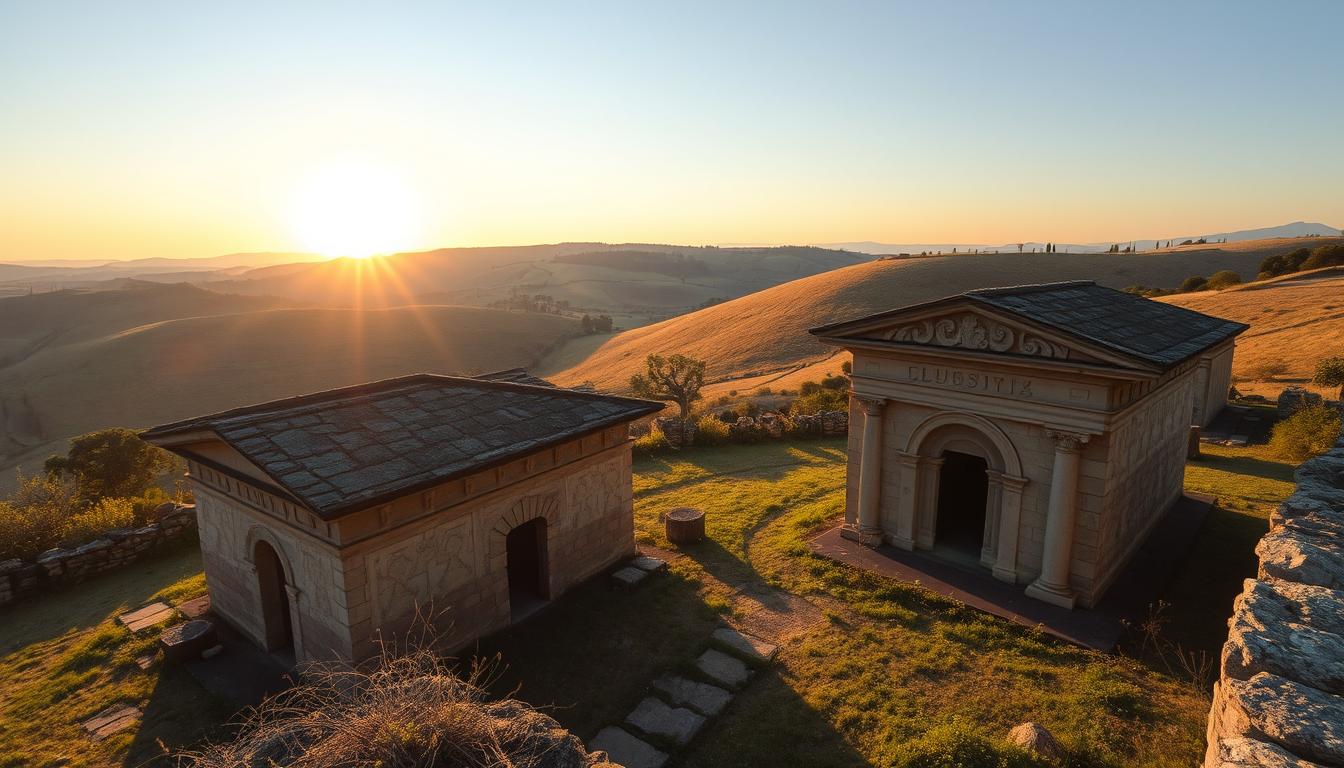
I plan short, easy routes through officially protected parks and archaeological areas to reveal rich old burial landscapes fast. I focus on clear signs you can spot from the road: tumuli shapes, carved chamber entrances, and rough basalt-like paving on ancient streets.
My approach pairs field visits with a nearby museum so artifacts and context click the same day. For example, I link Sodo with MAEC in Cortona or Populonia’s necropolis with displays in Piombino.
I sketch sea-to-hills variety, from coastal iron-working places at Populonia to the tuff cliffs and vie cave near Sovana. Signage varies: some parks guide you well, while small sites near farms need extra maps and a flexible mindset.
Quick safety tips: hydrate, protect from the sun, and wear shoes with good traction for uneven stone, especially in summer. By “hidden” I mean low-crowd, high-reward corners inside recognized archaeological areas, not off-limits digs.
Key Takeaways
- Look for tumuli, carved entrances, and rough paving as early site clues.
- Pair a field visit with a local museum for fuller context.
- Expect variety: coastal iron zones and inland tuff cliffs.
- Some sites are waymarked; others need maps and flexibility.
- Plan light for photography and pack sun, water, and sturdy shoes.
How I plan simple routes for discovering Etruscan tombs in Tuscany today
I map compact field loops that balance short walks, clear landmarks, and a museum stop so I can see artifacts and rock-cut façades in one visit.
Reading the landscape: tumuli, cyclopean walls, and vie cave at a glance
I first scan for rounded mounds, cut-stone rings, and sunken streets that point to burial complexes. In tuff country, the vie cave act as natural guides to façaded chambers.
I use visible cyclopean walls at places like Roselle to orient myself and guess where necropolis streets or gates once stood.
“Look for oblique light on carved edges—low sun reveals chisel work better than midday.”
Safety, signage, and museum pairings in small towns and archaeological parks
I pick a compact area with 2–3 highlights and a nearby museum. This keeps visits short and anchored.
- Check park sites for open access and path closures before you go.
- Carry water, a brimmed hat, grippy shoes, and a small flashlight.
- Allow time in the nearest center to watch how ancient routes shape modern urban fabric social life.
| Clue | Example site | Quick tip |
|---|---|---|
| Rounded mounds | Sovana (Città del Tufo) | Approach at low sun for relief details |
| Cyclopean walls | Roselle | Use walls to find nearby necropolis streets |
| Vie cave (sunken roads) | Vitozza | Follow vie cave into cliff façades |
Footsteps etruscansdirections_bike5.4 kmfrom and simple maps keep me on track when I switch between signed trails and quieter side tracks.
Coastal escape: Baratti & Populonia’s sea-view necropolis and acropolis
I craft a half-day loop from Baratti that stitches shoreline slag fields to the acropolis terraces above. The Baratti and Populonia Archaeological Park spreads across a coastal area where burial fields meet iron-working remains linked to Elba.
Lower park highlights: Necropoli di San Cerbone and industrial iron-working areas
I begin at the lower park where the Necropoli di San Cerbone sits on sandy flats and scrub. The broad Tomba dei Cari reads clearly from the path in strong light.
I trace the shoreline arc to find slag fields and panels that explain why Populonia thrived as a seaside area. These interpretive displays link workshops to trade with Elba.
Upper acropolis walk: temple foundations, terracing, and a rough-paved road
From the lower sites I climb to the acropolis plateau. Here are temple foundations, Roman additions, and substantial terracing.
A rough-paved road runs across the plateau; low-angle afternoon light makes tooling marks and curb stones stand out. This helps me imagine the civic site above the necropolis below.
My quick directions and best light on the Etruscan Coast near Piombino
I park by Baratti beach early, follow signed paths into the necropolis, then drive up to Populonia Alta for the acropolis loop and bay views. Look for the interpretive maps that connect workshop zones, tomb fields, and terraces—they make the coast’s trade story click.
“Park early at Baratti, shoot façades mid-to-late afternoon, and save Populonia Alta for lunch and sunset views.”
- Plan: budget half a day to combine lower paths and upper sites.
- Light: mid-late afternoon for façades; low sun shows pavement texture.
- Logistics: park at Baratti, then a short drive up to Populonia Alta; ideal for short places stops and photos.
For a compact outing with clear sights, this loop ties shoreline industry and civic remains into a single, scenic visit. I often note it on my list when I’m discovering the etruscan coast piombino and the coast piombino baratti stretch on daysdirections_car3 legs62 kmdiscovering and similar short itineraries like piombino baratti headlanddirections_bike9.4.
Maremma tuff country: Sovana’s monumental facades and the vie cave
In the Maremma tuff zone I follow sunken corridors and cliff façades to read a layered burial landscape up close. The Città del Tufo area links Sorano, Sovana, and Vitozza and rewards short, focused walks.
The Necropoli di Sovana includes the Tomba Ildebranda with carved columns and stairs, the Tomba dei Demoni Alati, the Tomba del Tifone, and the Tomba della Sirena. I target these sites to compare sculptural programs across a single necropolis.
Don’t miss: Tomba Ildebranda, Tomba dei Demoni Alati, and Tomba della Sirena
I photograph façades in morning light when shadows reveal fluting and cornices. I pause at low panels that explain carving methods—Ildebranda rewards slow looking.
Walking the vie cave safely in summer heat
I walk selected vie cave to connect clusters of sites. These sunken ways stay cool but can be slick, so I wear good tread, use trekking poles, and move slowly downhill.
- I carry two liters of water per person, a brimmed hat, and start early for great light and great escapes summer.
- I avoid unlit voids and stick to marked paths listed by the park.
- After visits I take lunch in nearby beautiful tuscan villages to tie ancient and medieval layers together.
“Log distances conservatively: vie cave loops feel longer because of elevation and winding cuts.”
Valdichiana loop: Chiusi to Cortona for painted tombs and “Meloni”
I stitch a short loop from Chiusi to Cortona so painted chambers and grassy Meloni read as one landscape. I start early in the town of Chiusi to reach Poggio Renzo while light brings out pigments and carved details.
Poggio Renzo near Chiusi: Tomb of the Monkey and neighboring chambers
At Poggio Renzo the Tomb of the Monkey anchors a compact group of painted and chamber tombs. I move slowly with a guide when access is limited and then visit the Museo Archeologico Etrusco di Chiusi to match finds with architecture.
Cortona’s Sodo: how to spot the “Meloni” and link it with MAEC in the center
I drive the ridge to Sodo, scanning grassy domes and stone revetments that signal buried tumuli. Three major funerary Meloni sit near the park and link directly to objects displayed at MAEC in Cortona’s center.
- Timing: Chiusi in the morning, Cortona late afternoon for the best light.
- Practical: book guided entries, use low‑ISO settings, and brace the camera in dim interiors.
- Tip: finish with an espresso and a look across the Valdichiana to trace ancient roads.
“Pairing field visits with museum stops makes motifs and chronology stick.”
Prato hills sampler: Carmignano’s scattered tumuli and necropolis
I trace low stone rings across Montalbano’s slopes to read how settlement and burial choices align in the Carmignano area.
I plan a compact loop that links the Montefortini Tumulus, the Tomba Boschetti at Comeana, and the Prato Rosello necropolis. Each site sits a short drive apart, so I can cover three highlights in a half-day without rushing.
Montefortini, Comeana, and Prato Rosello
At Montefortini I watch for long, low stone rings and earth domes that mark massed burials. At Comeana I study corridor roofing and orthostats to compare construction across adjacent sites.
- Museum stop: I visit Artimino’s museum to see finds that link Pietramarina settlement to the necropolis.
- Practical: pick places with easy parking, bring a small flashlight, and time visits for softer light.
- Finish: a short stroll through Artimino’s core reveals a beautiful medieval village feel and views over olive groves.
“Track distances conservatively: narrow lanes make driving slow but keep the loop calm and scenic.”
etruscan tombs tuscany: my top hidden places and what to look for
I favor short, focused stops so a beginner can spot key features fast. I shortlist a few clear places: Populonia’s tumuli rings, Sovana’s façaded chambers, and Carmignano’s textbook forms.
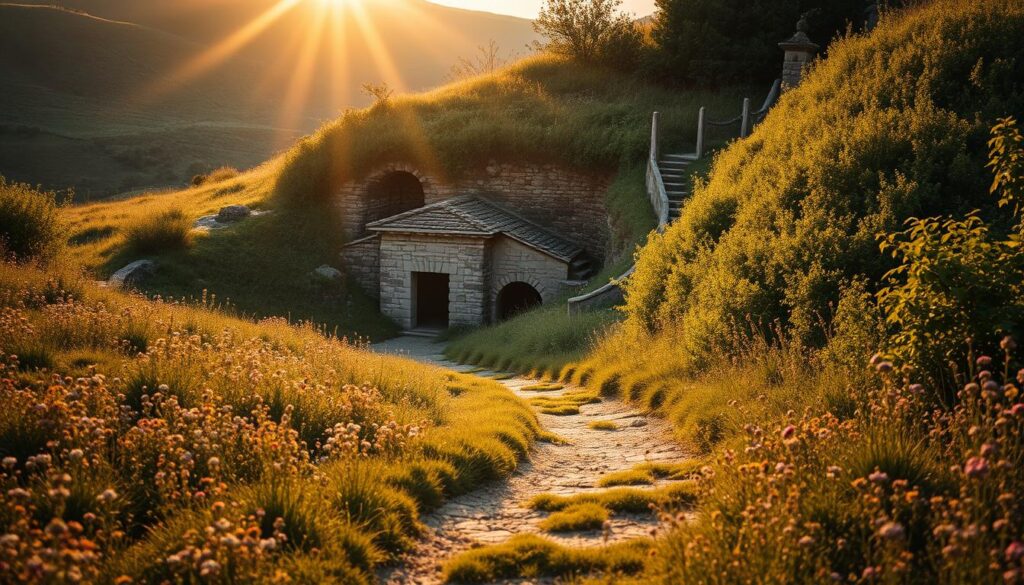
Clues in the stone: chamber plans, reliefs, and paint traces
I read chamber plans as echoes of domestic life—pillars as posts, benches like beds, and carved ceilings that mimic beams. I scan soffits and door frames for faint reds or blacks; even small paint traces change a simple burial into a ritual scene.
Pairing sites with nearby villages, town centers, and small museums
I always link a field stop to a nearby museum or café in local villages. That lets me match iconography on urns with stone details and see how ancient layouts shape modern urban fabric social.
- I check masonry joins in walls to tell original work from later repairs.
- I compare dromoi types—straight, dogleg, or stair—to read rank and processional life.
- I sketch plans in a notebook and avoid touching carved lintels or reliefs to protect fragile surfaces.
Quick rule: short visits, paired museums, and a café break make details stick.
Vetulonia and Roselle: big walls, big tumuli, and open-air ruins
I drive into low, scrubby hills to read how monumental burial architecture sits in the landscape.
The Vetulonia archaeological area contains large, well‑preserved necropolis fields. I walk around the Pietrera and Diavolino mounds above Castiglione della Pescaia to feel their scale.
Vetulonia’s Pietrera and Diavolino on the hill
I circle each tumulus to find dromoi, retaining walls, and entry cuts. These features show how earth and stone were combined to make monumental forms.
I time Vetulonia for mid‑morning light. That angle helps me photograph massing with a wide lens and pick out retaining courses with a longer focal length.
Roselle’s cyclopean defenses and the Serpaio necropolis
At Roselle I study the cyclopean circuit, then step into forum and baths where Roman layers knit into earlier fabric.
The Serpaio necropolis has chamber, shaft, and pit graves and a tumulus, all within a compact area. I compare burial techniques across status and periods here.
“I pair both towns with short views and cafés so a museum stop or espresso breaks the walking.”
- I watch for interpretive maps that show city plans and gate alignments.
- I carry water and a hat; both sites are open‑air and can be exposed in summer.
- I photograph with wide and tele lenses, and heed signage near fragile shaft graves.
Sarteano’s Pianacce: Tomba della Quadriga Infernale up close
A guided visit at Sarteano lets me see a rare painted chariot scene in tight, controlled light. The Necropoli delle Pianacce revealed the tomba della Quadriga Infernale in 2003.
The 4th‑century BCE fresco shows Charun driving a chariot pulled by two lions and two griffins. Behind the team is a banquet scene and a large, three‑headed serpent.
Reading the frescoes: Charun, the banquet, and the three-headed serpent
I book a guided slot so I can focus on pigments and composition. I study the chariot team first, then the feast imagery, and finally the serpent. That sequence reveals layers of afterlife meaning.
- I shoot no‑flash photos only where allowed and let my eyes adjust to dim light.
- I bring a light jacket; underground spaces stay cool and can be damp.
- After the visit I walk the necropolis paths for context, then return to Sarteano’s center.
| Feature | What to look for | Follow-up |
|---|---|---|
| Painted chariot | Charun, lions, griffins | Compare line work to Chiusi examples |
| Banquet scene | Figures, vessels, ritual gestures | See matching vases at the museum |
| Three‑headed serpent | Large motif, strong outlines | Note preservation and park access rules |
I finish at the Archaeological museum in the town center, where vases from the necropolis anchor the painted program. I log contacts and seasonal hours in my notes and add an entry for etruscansdirections_walk2 legs17 kmdiscovering to my route list.
Chianciano Terme area: farms, sacred spaces, and spread-out burial sites
I map a gentle loop that links Chianciano’s museum with several outlying necropolis clusters and working farms. This lets me compare finds in town with field evidence in a single, slow day.
I visit the Tomb of the Pedata, then hop to Poggio Bacherina to see an Etruscan farmstead and rural production traces tied to daily life—useful for etruscan timesdirections_car230 kmolive studies. Short drives bring me to the Tolle and Morelli necropolis fields and the sacred spring at Fucoli.
I limit stops to two or three. Distances, parking, and small pull-offs make this a slow‑burn itinerary, so I pack a picnic and plan shade breaks.
- Photo tips: shoot earthworks and low revetments at low sun to read texture.
- Practical: budget extra time for dispersed signage and short walks from roadside parking.
- Respect: stay on marked ways near active farms and close gates as found.
I always start or finish at the town museum so artifacts anchor the field site visits. Noting worked tuff versus fieldstone helps me tell original fabric from later repairs and rounds out my itineraries lands etruscansdirections_walk2 pattern.
Volterra and Florence: museum stops that make the tombs make sense
I spend a short museum hour before fieldwork so gallery objects frame what I expect to see outdoors.
Volterra’s Museo Guarnacci: L’Ombra della sera and the Urna degli Sposi
At Museo Guarnacci I study L’Ombra della sera and the Urna degli Sposi closely. These pieces sharpen my eye for iconography I later seek at nearby tombs.
I also walk the old gate and town center to sense how civic space relates to burial zones.
National Archaeological Museum of Florence: a quick primer before the field
The archaeological museum florence is my field primer. Ceramics, bronzes, and carved urns give me a mental toolkit for reading rock-cut architecture.
I jot dates, motifs, and lid profiles in a small notebook. That list helps when I visit Sovana, Chiusi, or Sarteano.
- I time museums for midday heat or rain, leaving mornings and late afternoons for outdoor light.
- I plan short drives or a train between each center and the field, so museum time doubles as practical route planning.
- I finish at a nearby café to cement takeaways before I head back to the trail or car.
“Gallery study makes weathered stone read like a labeled page.”
Seasonal notes and gear: making summer tomb-tripping easy
My summer packing and timing aim to keep field loops short, safe, and photo-ready.
Packing matters more than extra lenses. I bring a wide-brim hat, refillable bottles, sunscreen, grippy shoes, and a compact flashlight or small headlamp for dim chambers.
I carry a paper map backup and offline maps on my phone because rural coverage can be patchy. I also tuck a microfibre cloth to wipe lens haze and a few electrolyte packets for long, hot legs.
Timing is key: I start early and finish late, using midday for a long shaded lunch or a stop at the archaeological museum florence when heat peaks.
- I confirm opening hours the morning of my visit; access can change for conservation.
- I favor breathable clothing and a small daypack; short loops can feel longer on uneven stone.
- I track driving segments conservatively and watch signage so I stay on intended routes.
“Light planning and the right kit turn hot days into great escapes summer with calm, focused walking.”
Conclusion
Conclusion
I end with a simple rule: one compact site cluster and a museum per day turns wandering into calm, memorable great escapes summer.
Pair the coast—Populonia’s necropolis and acropolis—with an inland town day at Sovana, Vetulonia, or Roselle to see range in scale and setting.
Read façades, chamber plans, and reliefs slowly, then check motifs at the Archaeological Museum Florence or Volterra’s Guarnacci. Use cafés and small squares in beautiful tuscan villages to pace the day.
I leave one strong, simple checklist: water, hat, good shoes, offline maps, and a museum pairing. Respect closures, return at different light, and let mental maps link necropolis streets with ridge-top town plans.
Start with the Etruscan Coast at Populonia or the tuff heartland near Sovana, and enjoy the next carved threshold waiting around the bend.