

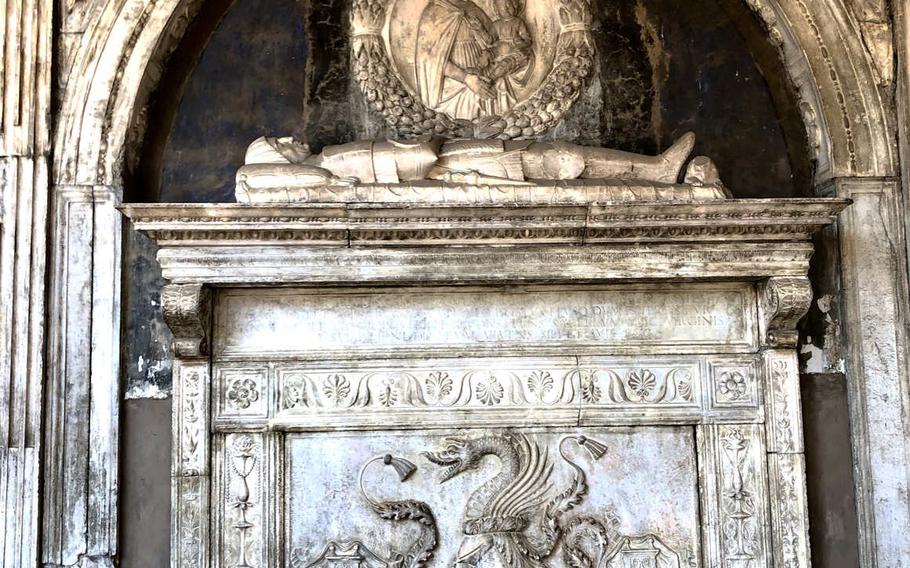
For centuries, the final resting place of Vlad III “the Impaler”, the historical figure behind the legend of Dracula, has remained a mystery. In 2025 new evidence has revived the bold claim that his tomb lies not in Romania, but in a modest chapel in Naples, Italy.
The Emerging Theory
- Since 2014, a team of Italian and Estonian scholars has proposed that Vlad’s remains might be located in the Turbolo Chapel of the Santa Maria la Nova complex, in Naples. GreekReporter.com+4www.visitnaples.eu/+4RaiNews+4
- The case rests on symbolic clues carved into a marble tomb that traditionally holds the remains of Matteo Ferrillo. www.visitnaples.eu/+3Wikipedia+3euronews+3
- Among the motifs are a dragon-headed helmet, sphinxes, and inscriptions in multiple scripts — all of which neutrally attract attention from epigraphists and historians. GreekReporter.com+4euronews+4RaiNews+4
The 2025 Breakthrough: Deciphered Inscription
The latest twist arrived mid-2025, when researchers announced they had decoded part of the mysterious inscription. Jerusalem Post+5Fanpage+5RaiNews+5
Key points from this work:
- The text may be a funerary eulogy that references an Eastern prince, captured by Turks, and later rescued by a daughter. GreekReporter.com+5RaiNews+5Panorama+5
- Although the name Vlad does not appear explicitly, scholars argue that terms like “Blad” and “Balkan” in the inscription point to him. AS USA+3UNILAD+3Jerusalem Post+3
- The director of Santa Maria la Nova, Giuseppe Reale, is reported to have confirmed that the inscription aligns with clues already known from prior studies in Naples and abroad. RaiNews+2euronews+2
If confirmed, this would challenge the long-held narrative that Vlad died in battle in Wallachia around 1476 and was buried locally or in a monastery in Romania. GreekReporter.com+5euronews+5Jerusalem Post+5
Historical and Scholarly Doubts
Despite excitement, major challenges remain:
- Consensus is lacking. Many historians are skeptical about translating symbolic motifs into firm identity claims.
- Maria Balsa hypothesis is controversial. The theory holds that Vlad had a daughter, Maria Balsa, who fled to Naples and arranged her father’s tomb in her father-in-law’s burial site (Ferrillo’s). But most accepted sources list only male descendants, and no firm archival evidence supports this lineage. Wikipedia+3Wikipedia+3Wikipedia+3
- Heraldic ambiguity. A dragon motif might refer simply to the Ferrillo family or general heraldry, not Vlad’s association with the “Order of the Dragon.” Wikipedia+4Wikipedia+4Panorama+4
- Inscription ambiguity. The inscription is fragmentary, and parts remain undeciphered or open to alternate readings. Wikipedia+4euronews+4Panorama+4
Why This Matters
- If validated, the discovery would retrace Dracula’s historical narrative — linking Naples to one of Europe’s most notorious rulers.
- It would spur archaeological and forensic interest in the tomb, potentially unlocking more evidence (bones, DNA, isotopes).
- The find would boost tourism and cultural intrigue in Naples, making the city a focal point for Dracula lore in a way few other locations can rival.
The Road Ahead
- Scholars will press for permissions to excavate or sample the tomb, though such work faces legal, religious, and conservation constraints.
- They will continue cross-disciplinary analysis—epigraphy, archaeology, DNA, archival study—to substantiate or refute the claim.
- Only after rigorous peer review and material evidence (e.g. skeletal remains matching Vlad’s era and origin) can the claim move from sensational theory to accepted history.