


I begin this journey into Italy’s concealed artistic patrimony with a revelation. Beyond the crowded corridors of Florence’s Uffizi and the tourist-thronged piazzas of Rome lies a parallel universe of medieval masterworks. These places reward the discerning traveler who seeks authenticity over spectacle.
The story of Manta Castle represents more than a single monument. It embodies a rich tradition that flourished across the peninsula during the medieval period. Aristocratic patrons commissioned frescoes that transformed fortress walls into narrative canvases of extraordinary sophistication.
My fascination with these spaces stems from a simple belief. True cultural enrichment requires moving beyond predictable itineraries. We must venture into territories where creation reveals itself not as a commodity, but as a living testament to human creativity.
This article serves as both a practical guide and a philosophical meditation. It offers concrete information while encouraging deeper reflection. We will explore what it means to engage meaningfully with cultural heritage in our contemporary moment.
Key Takeaways
- Discover a significant medieval artistic treasure located away from Italy’s main tourist hubs.
- Understand how aristocratic patronage transformed castles into sophisticated narrative spaces.
- Learn the value of seeking authentic cultural experiences beyond standard travel guides.
- Gain insight into the technical and narrative complexity of pre-Renaissance artwork.
- Prepare for a journey that combines practical travel advice with deeper cultural reflection.
Introduction to Italy’s Hidden Italian Art
To truly grasp the genius of medieval frescoes, one must first understand the demanding technique that gave them life. This method, reaching its peak in the 14th century, required immense skill.
An Overview of Medieval Frescoes
Artists applied pigment to wet plaster, creating a permanent bond as it dried. This work had to be completed swiftly, demanding precision and foresight. The result is a fresco whose colors have endured for centuries.
I have always been struck by the symbolic power of these paintings. They communicate complex narratives through a visual language of faith and power. This approach prioritizes clarity over the naturalism of later time periods.
Historical Context and Cultural Significance
Wealthy patrons commissioned artists to transform castles and churches into immersive spiritual environments. These spaces served as powerful tools for teaching people, many of whom were illiterate.
The cultural value of these works extends far beyond their beauty. They offer a direct window into the social structures and beliefs of medieval communities. They are primary historical documents, capturing a worldview in vibrant color.
| Aspect | Medieval Emphasis | Primary Function | Enduring Quality |
|---|---|---|---|
| Technique | Buon Fresco (wet plaster) | Permanent integration with architecture | Remarkable color vibrancy |
| Narrative Style | Symbolic and didactic | Educate and inspire devotion | Universal thematic resonance |
| Patronage | Aristocratic and religious | Display power and faith | Historical record of patronage |
Manta Castle and Its Enigmatic Frescoes
Stepping into the Baronial Hall of Manta Castle feels like crossing a temporal threshold. The austere stone building in Piedmont gives little hint of the vibrant world contained within its walls.
The walls themselves become vast narrative panels. They depict a chivalric world from the early 15th century. Knights, ladies, and allegorical figures from “Le Chevalier Errant” come to life.
These artworks are distinguished by their remarkable preservation. You can appreciate them in contemplative solitude, a rare privilege.
Unveiling the Secrets Behind the Walls
The façade of the castle is deliberately unassuming. This embodies a beautiful principle of travel. The greatest treasures are often hidden in plain sight.
The display of these pieces is crucial. They remain in situ, not in a museum. This preserves the powerful link between the art and the architecture.
The Manta frescoes are a masterclass in courtly propaganda. They use legendary heroes to legitimize authority, blending politics with aesthetic brilliance.
I was struck by the chromatic intensity of the pigments. The skill of the unknown master is evident in every figure. This sophistication challenges assumptions about provincial italian art.
Discovering these panels is an act of cultural archaeology. It connects us to a moment where art was an essential part of life and power.
| Narrative Panel | Primary Figures | Symbolic Meaning |
|---|---|---|
| The Nine Worthies | Historical & Legendary Heroes | Idealized virtue and justified rulership |
| Fountain of Youth | Courtly Figures | Allegory of renewal and eternal ideals |
| Le Chevalier Errant | The Wandering Knight | Quest for purpose and chivalric code |
Exploring Hidden Italian Art in Medieval Architecture
Walking through a castle room adorned with original frescoes offers a different kind of museum experience—one where art and architecture merge seamlessly. This integration transforms defensive structures into sophisticated environments that communicate power and cultural refinement.
The Role of Frescoes in Castle Design
Medieval fresco programs were carefully calibrated to each room’s specific function. Unlike cathedral sculpture designed for public viewing, castle frescoes created private experiences reserved for aristocratic families. This privacy paradoxically contributed to their remarkable preservation.
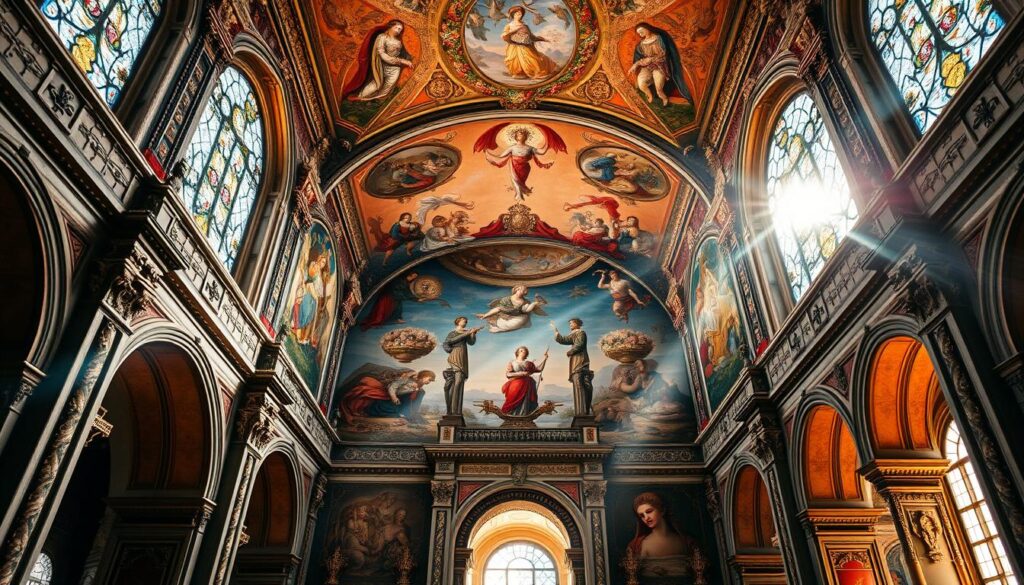
The work of decorating castle interiors required artists to solve complex spatial challenges. They adapted compositions to irregular walls and varying light conditions. Their problem-solving abilities rival those of Renaissance masters.
For modern visitors, approaching these spaces requires recalibrating expectations. We must abandon passive museum spectatorship for active engagement. The art functioned as backdrop to daily life rather than isolated objects.
The relationship between fresco and architecture reveals sophisticated spatial understanding. Painted elements created illusions of depth and established hierarchical relationships. This anticipates later Baroque developments while maintaining medieval characteristics.
| Castle Space | Primary Fresco Theme | Intended Audience | Spatial Effect |
|---|---|---|---|
| Great Hall | Chivalric narratives & power displays | Guests and courtiers | Amplified grandeur and authority |
| Private Chambers | Devotional scenes & personal symbolism | Family members | Intimate spiritual atmosphere |
| Chapel | Biblical stories & saints’ lives | Religious community | Enhanced sacred experience |
| Council Room | Allegorical wisdom & governance | Advisors and officials | Focused intellectual environment |
The reward for seeking these sites is an authentic encounter with medieval creativity. Visitors experience art in its original context, free from institutional mediation. Each room becomes a total artwork engaging multiple senses simultaneously.
Unique Artistic Techniques and Timeless Mastery
The marble floor of Siena’s Duomo presents a different kind of artistic pilgrimage—one that unfolds beneath your feet rather than before your eyes. This magnificent floor comprises over fifty narrative panels created by Sienese artists across four centuries. The experience of viewing these works requires a complete reorientation of how we engage with medieval creativity.
Grafitto and Intarsia: From Rough Beginnings to Intricate Details
The earliest panels, dating to the late 14th century, employ the grafitto technique. Artists scratched lines directly into white marble, filling them with dark pitch to create striking graphic contrasts. This method gave the floor a distinctive quality quite separate from wall painting.
I find the evolution to intarsia particularly revealing. Later artists mastered the intricate process of inlaying colored marble pieces. They achieved complex pictorial effects through stone selection rather than pigment application.
The Transition from Medieval to Renaissance Styles
These works document a gradual aesthetic shift across centuries. Early panels emphasize symbolic clarity and decorative patterns characteristic of medieval sensibility. Later compositions incorporate perspective and naturalistic elements anticipating Renaissance ideals.
The viewing experience itself becomes part of the narrative. Visitors navigate narrow walkways between protected panels, creating a choreographed physical engagement. This active observation connects us to the artists‘ original intention—art integrated into daily life.
Notable Artworks and Architectural Panels in Italy
The true heart of Florence’s Duomo complex beats not in the main church but in an adjacent museum of profound significance. The Museo dell’Opera del Duomo serves as the cathedral’s artistic memory, housing original masterpieces removed for preservation.
Iconic Pieces and Their Stories
Within this remarkable institution, Ghiberti’s gilded Porta del Paradiso demonstrates the technical brilliance of Renaissance sculpture. The gleaming bronze panels mark a pivotal transition in artistic achievement.
Donatello’s wooden Mary Magdalene presents a stark departure from idealized beauty. This haunting sculpture reveals the Renaissance capacity for raw emotional expression through unflinching physical detail.
Perhaps most compelling is Michelangelo’s Florentine Pietà. Created when the artist was in his seventies for his own tomb, the work bears visible scars of his frustration. Michelangelo damaged Christ’s arm and leg, transforming the piece into a meditation on mortality.
The museum’s exhibit on Brunelleschi’s engineering marvel provides essential context. From the Terrazza Brunelleschi, visitors gain unparalleled views of the dome that defines Florence’s skyline.
I value the Opera del Duomo precisely because it remains overlooked. This allows for the sustained contemplation that Florence’s crowded attractions often preclude.
A Visitor’s Guide to Experiencing Italy’s Inner Artistic Gems
Strategic planning transforms the experience of encountering Italy’s artistic treasures from crowded obligation to personal revelation. The difference between superficial viewing and profound engagement often lies in thoughtful preparation.
Essential Tips for Art Enthusiasts
I always research reservation requirements before any cultural excursion. Venues like Arezzo’s Bacci Chapel now mandate timed entry slots. Securing these in advance ensures uninterrupted viewing.
Private guides offer invaluable insights that generic tour groups cannot provide. Their specialized knowledge reveals layers of meaning in each masterpiece. This transforms a simple visit into an educational journey.
Best Times and Spots for an Immersive Experience
Timing dramatically affects crowd levels. I avoid conventional tour schedules by arriving at opening or during final hours. This strategy provides the contemplative space these works deserve.
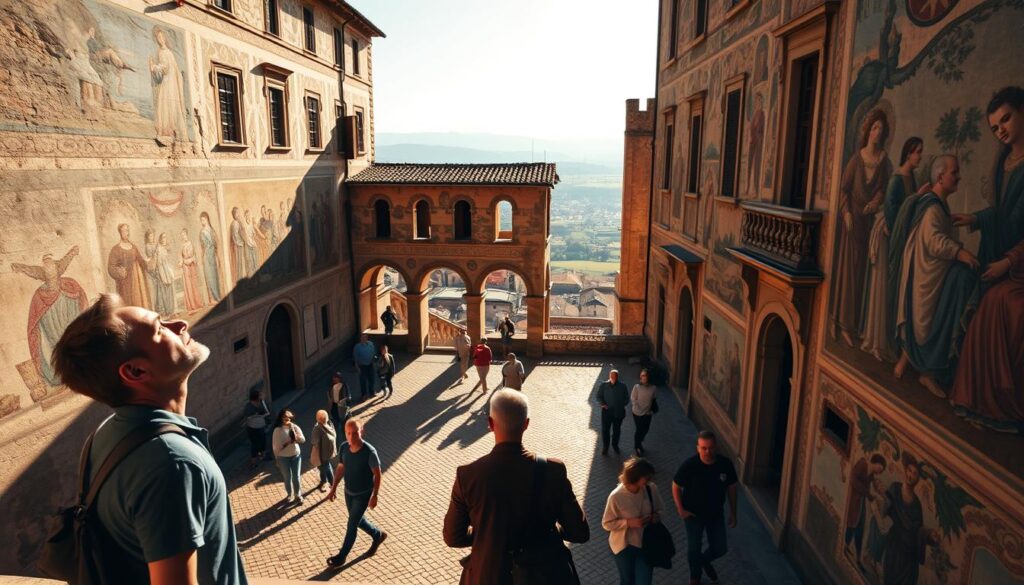
Beyond main attractions, I seek out neighborhood churches and civic buildings. These spaces often house extraordinary gems without the crowds. Exploring a city‘s residential areas reveals artworks in their original contexts.
| Planning Approach | Ideal Timing | Crowd Level | Experience Quality |
|---|---|---|---|
| Advanced Reservation | Weekday openings | Low | Highly immersive |
| Private Guided Tour | Off-peak seasons | Controlled | Educational depth |
| Independent Exploration | Late afternoons | Variable | Personal discovery |
| Combined Ticket Strategy | Full day planning | Managed | Comprehensive view |
These practical tips help visitors maximize their limited time. Thoughtful travel planning ensures each encounter with Italy’s cultural heritage becomes meaningful rather than rushed.
Comparing Medieval Frescoes with Renaissance Art
Standing before both medieval and Renaissance masterpieces, I’ve come to appreciate how each era expressed its worldview through distinct visual languages. The transition represents not a sudden revolution but a thoughtful evolution spanning generations.
Evolution of Artistic Expression Through the Centuries
Medieval frescoes prioritized symbolic clarity and spiritual instruction. Artists communicated through established iconographic conventions rather than direct observation. This approach created works of profound devotional power.
The fifteenth century witnessed dramatic changes. Masters like Masaccio applied mathematical principles to painting. They transformed flat surfaces into illusionistic windows extending architectural space.
Renaissance art built upon medieval foundations rather than rejecting them. Artists retained the fresco technique while introducing new formal possibilities. This evolution reflected broader intellectual transformations across society.
Influence on Contemporary Art Styles
Contemporary creators continue drawing inspiration from both traditions. Some embrace medieval flatness and pattern for its symbolic directness. Others explore Renaissance spatial construction for its naturalistic depth.
These historical works remain vital sources for modern art. They demonstrate that artistic progress involves both gains and losses. Each era offers unique aesthetic experiences worth preserving.
Insights from Art Historians and Cultural Experts
Behind every preserved fresco and sculpture lies a complex story of discovery, conservation, and interpretation. These narratives reveal how cultural treasures survive across centuries through both intentional protection and accidental preservation.
Perspectives from Conservation Specialists
Dr. David Saunders of the British Museum emphasizes how archaeological discoveries reshape our understanding. The Siena Crypt frescoes remained buried until recent excavations revealed their vibrant colors, protected from light for centuries.
I’ve learned that museum display contexts inevitably alter our relationship to individual pieces. Even in repurposed historical settings, artworks become isolated from their original architectural environments.
“The discovery of works like the Siena Crypt frescoes rewards sustained attention rather than offering immediate visual impact favored by mass tourism.”
Expert Analyses and Critical Acclaim
Conservation specialists stress that environmental factors demand constant attention. Temperature, humidity, and light exposure can dramatically affect preservation outcomes for delicate works.
The sensitive restoration of Piero della Francesca’s cycle in Arezzo demonstrates how modern techniques can recover original chromatic intensity. This allows contemporary people to experience these works much as their original audiences did.
| Art Type | Primary Threats | Conservation Approach |
|---|---|---|
| Frescoes | Moisture, temperature fluctuations | Environmental control, minimal intervention |
| Sculptures | Physical damage, pollution | Protective cases, regular monitoring |
| Museum buildings | Structural aging, visitor impact | Adaptive reuse, controlled access |
These expert perspectives remind me that our encounters with cultural heritage depend on invisible labor. Conservation professionals create the conditions that make aesthetic experience possible for all visitors.
Engaging Tours and Immersive Art Exploration Opportunities
Specialized tours focusing on specific artistic themes or neighborhoods offer a pathway to experiences that transcend conventional tourist itineraries. These curated journeys allow for deeper engagement with Florence’s cultural treasures.
Highlights from Italy’s Premier Art Destinations
The Museo di San Marco presents an exceptional concentration of Fra’ Angelico’s devotional works. His celebrated Annunciation greets visitors at the stairway’s summit, while the monks’ cells feature intimate frescoes by this master painter and his collaborators.
Santa Felicità houses the Barbadori chapel, a Brunelleschi design adorned with Pontormo’s vibrant Mannerist frescoes. Nearby, Santa Maria Maddalena de’ Pazzi preserves Perugino’s magnificent Crucifixion, a work of spatial clarity that remains one of Florence’s true hidden gems.
Guided Tours, Local Insights, and Insider Tips
Knowledgeable guides reveal connections between seemingly separate sites. They can explain how the same painter worked across different churches, creating a richer understanding of artistic networks.
The Basilica of San Lorenzo demonstrates how architecture and artworks interact. Brunelleschi’s Old Sacristy features Donatello’s sculptural decoration, while the crypt contains the sculptor’s grave. The dome above completes this integrated experience.
I recommend seeking out lesser-known spaces like the Chiostro dello Scalzo. This glass-enclosed cloister features Andrea del Sarto’s grayscale fresco series and offers peaceful contemplation away from crowded areas of the city.
Conclusion
What began as a quest to discover overlooked masterpieces has evolved into a meditation on the very nature of artistic discovery and preservation. These cultural gems—from Manta Castle’s vibrant frescoes to Siena Cathedral’s intricate marble floor panels—represent not secondary attractions but primary achievements that demand our attention.
Each room and chapel reveals how medieval and Renaissance masters created artworks of extraordinary sophistication. The transition from symbolic medieval paintings to Renaissance naturalism becomes tangible when experienced in original contexts rather than sterile museum displays.
This journey demonstrates that Italy’s artistic patrimony extends far beyond famous cathedral façades. The quiet contemplation of del Sarto’s grayscale frescoes or anonymous craftsmen’s marble panels offers rewards that crowded tourist sites cannot match.
True cultural travel requires moving beyond spectacular surfaces to discover works that functioned as essential parts of spiritual and social life. These encounters transform our understanding of artistic achievement across centuries.