

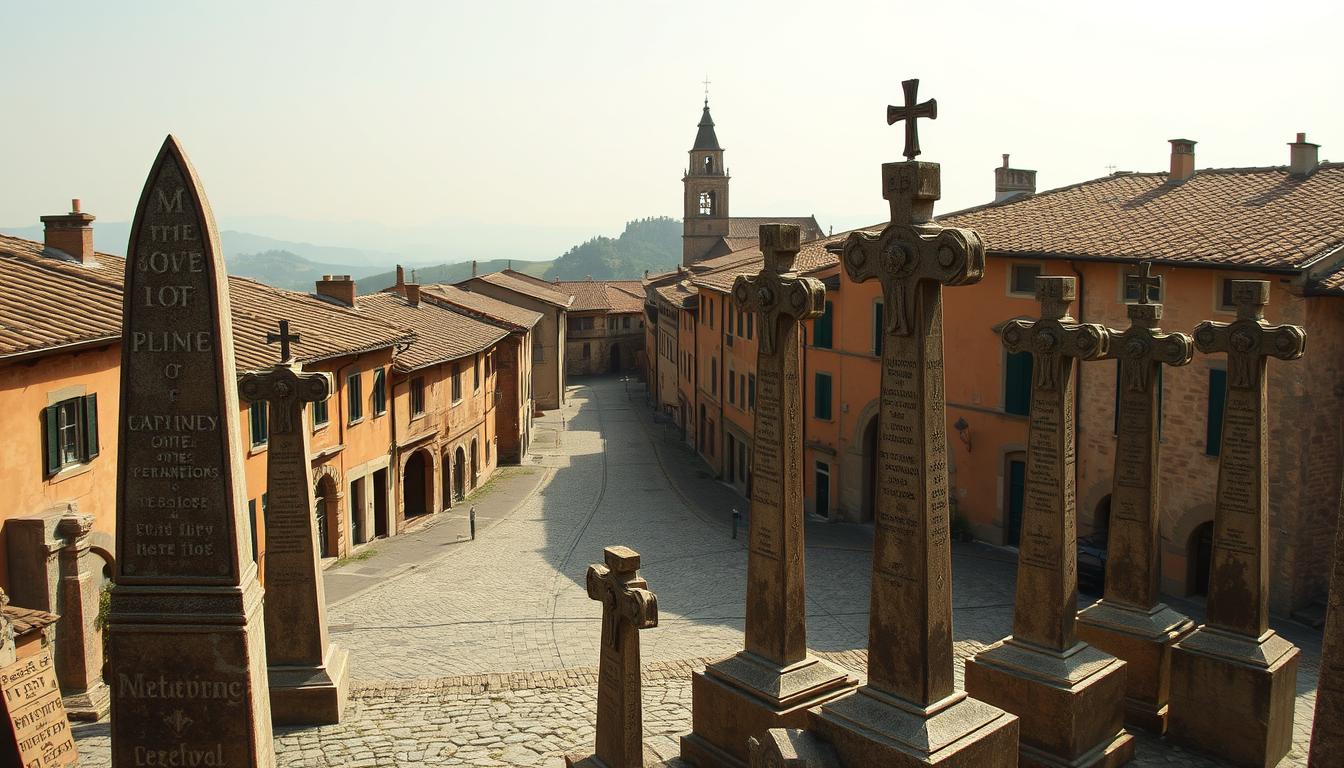
I introduce this guide from field notes and archive work. I use on-site observation and local records to read surviving signs and stones.
I explain how I tell apart temporary painted door signs from permanent structures that guided safer exchanges during a plague. This distinction matters for historians and travelers.
I define key terms up front, so you will know what I mean by a plague marker, a plague cross, and other memorials you may see in town centers.
Small towns often keep older street plans and continuous traditions. That makes it easier to find and interpret traces left by individuals and by communal responses.
In this article I preview comparative examples from Britain and Germany to avoid misreading later devotional or boundary crosses. I also outline practical field methods so you can apply these approaches to itineraries, museums, or parish files.
Key Takeaways
- I combine field observation with archival evidence to read markers responsibly.
- You will learn clear definitions for markers, crosses, and memorial forms.
- Small-town contexts preserve continuity that aids interpretation.
- Comparative cases help prevent misidentification of later features.
- The guide offers practical steps for site visits and archive research.
Why I wrote this ultimate guide to medieval plague markers
Years of walking town lanes in Lombardy, Piedmont, and Veneto taught me how stones and signs keep local memory alive.
I wrote this article because travelers and researchers needed a clear, evidence-based way to read the landscape in real time. Scattered panels and inconsistent local terms led many people to confuse civic crosses with disease-era memorials.
My method favors datable inscriptions, municipal records, and parish notes over anecdote. I triangulate what officials or diarists wrote at the time with what the stones and crosses physically show on site.
Living through a recent epidemic sharpened my questions about how communities signaled danger, organized aid, and managed space. Too many individuals left no written trace, so the built landscape often carries the best surviving narrative.
| Evidence type | Use | Example locations |
|---|---|---|
| Datable inscription | Anchors interpretation | Brugherio piazza stones |
| Municipal order | Confirms function | Veneto town ledgers |
| Physical wear | Shows use over years | Market crosses, Lombardy |
What medieval plague markers are: from door crosses to market stones
I begin by separating short-lived door signs from permanent trade stones. The term covers two related but distinct practices: painted crosses on houses and fixed structures set at roads or market edges.
Painted crosses on houses served as legal and visual quarantine notices. Daniel Defoe recorded a red cross “of a foot long in the middle of the door” with the plea
“Lord, have mercy upon us”
. These signs warned neighbors and tied a household to town orders.
Permanent structures: trading points and disinfecting stones
Fixed crosses, stone shafts, and troughs standardized where goods and coins changed hands. York set up mile-out stone crosses with basins in 1604. Derby and Wentworth used vinegar stones in 1665 to treat money, a practical attempt at minimising risk contagion.
Religious sacramentals
A third form is devotional: the Plague Cross of Saint Zacharias functioned as a worn sacramental. This cross acted spiritually, not as a spatial regulator.
- Key differences: temporary door crosses signaled quarantine; lasting cross shafts organized exchange.
- Look for worn troughs, junction siting, or market-edge placement to infer function.
Historical timeline: Black Death to later plague outbreaks
I chart the sequence from the 1348 pandemic through recurrent outbreaks that shaped civic practice. The mid-14th-century Black Death, caused by Yersinia pestis, hit England between 1348 and 1350 and reduced local population by an estimated 30–60%. That catastrophe framed how towns remembered disease for centuries.
In 1361 the pestis secunda returned with lower mortality, roughly 10–30%, yet it reinforced communal habits. Over the following centuries, new waves — including 1603–1604 and the severe 1665–1666 epidemic in London — kept authorities vigilant.
Responses across times and centuries
Across the 16th and 17th century, municipal leaders moved from ad-hoc notices to standardized devices. For example, York set up trading crosses in 1604 and Derby placed a vinegar stone in 1665 to treat money.
The distinction matters: the biological agent, the bubonic plague, is one thing; the broader social phenomenon of plagues and repeated outbreaks shaped what towns built and kept. Over years, towns placed exchange points just outside gates to limit contact between individuals and markets.
By the eighteenth century these epidemic shocks had largely faded in many regions. Yet many standing stones and crosses survived as memorials or reused features, leaving a layered record for me to read today.
Functions and meanings: minimising risk, enforcing quarantine, and offering protection
Field evidence reveals that boundary stones and crosses managed trade and fear at the same time. I read these features as tools that both guided movement and answered spiritual needs.
Minimising risk of contagion through boundary and market structures
I found civic leaders moved exchange to controlled points to reduce contact. Fixed structures at market edges let people trade at a single point and limited handling of coins.
Examples like York’s basins and Derby’s vinegar stone show practical attempts at minimising risk contagion in commerce.
Warning systems and quarantined areas in towns and rural locations
Fixed crosses often marked where quarantined areas began and ended. These lines usually followed parish or market boundaries.
Painted doors and wayside signs told people to avoid houses or to transact only at designated points. They functioned as immediate warning systems.
Communal prayer, resilience, and symbolism across periods
Communities gathered at crosses for outdoor worship when churches were closed. Inscriptions often asked God for mercy and protection.
Over time the same structures shifted roles: urgent warnings in the Black Death period; later, durable reminders of how people coped during a pandemic.
- Practical rationale: minimise risk by centralizing exchange at one point.
- Spatial control: delineate areas under watch to reduce risk contagion.
- Cultural meaning: blend regulation with devotion and public memory.
Types of markers you’ll encounter in small Italian towns
I describe the common forms I find in town streets and near parish edges. This short guide helps you spot functional and memorial features on a quick visit.
Plague crosses in situ (wayside and market crosses)
Look for modest shafts or pedestals set near old market edges or along approach roads to the city. These small crosses often mark a civic point where exchange was encouraged or controlled.
Clues: placement at junctions, simple shafts, and wear at the base from repeated handling by individuals.
Stones with water or vinegar troughs used during outbreaks
Some stones have carved basins or hollowed tops. In Britain, York’s 1604 roadside crosses had water pools for coin exchange; Derby and Wentworth used vinegar stones in 1665 to treat money.
The basin is a strong functional sign that the feature served a hygienic role in trade.
Memorial crosses for victims at churches and cemeteries
Near churches you may find larger memorial crosses recording names, dates, or a count of those who died. Ross-on-Wye’s “Corpse Cross” commemorates 315 people from a 1637 outbreak.
- Brugherio preserves three cross locations in Piazza Roma, Viale Lombardia, and Torazza.
- Check inscriptions for dates or appeals to mercy to tell civic use from later devotional reuse.
Case focus: Italy’s Brugherio plague crosses and what they reveal
In Brugherio the town’s three surviving crosses form a linked map of response and ritual.
Piazza Roma sits at the civic heart. The cross there faces an open square and carries faint inscriptions. Those marks align with market activity and a visible base worn by hands and offerings.
Viale Lombardia occupies a traffic corridor that once led toward surrounding fields. Its cross stands where movement between town and countryside concentrated during an outbreak. The siting suggests control of goods and routes.
Torazza lies close to a parish boundary. The Torazza cross shows base wear consistent with long devotional use. It also anchors processional lines recorded in later parish notes.
Open-air altars, 1576 and parish strategy
Local records reference open-air altars in 1576. These altars answered limits on indoor worship and placed sacrament close to where people gathered.
When individuals died plague, these crosses functioned as focal points for prayer, notice, and memory. They shaped both immediate care and later commemoration.
- I recommend consulting municipal ledgers and parish files for entries on processions, indulgences, or decrees tied to each cross.
- The trio’s distribution hints at a planned spatial response by the community rather than isolated devotional gestures.
| Site | Context | Evidence |
|---|---|---|
| Piazza Roma | Public square, market edge | Inscription fragments; worn base |
| Viale Lombardia | Traffic corridor to countryside | Siting aligned with routes; civic placement |
| Torazza | Parish boundary, processional route | Base wear; parish mentions of outdoor worship |
Comparative context: how Britain and Germany help decode Italian examples
Comparative examples from Britain and Germany sharpen the criteria I apply when reading Italian field evidence. I look for design features, siting, and inscriptions that point to either practical exchange or memorial use.
York and Derby: functional analogs for market points
York’s 1604 trading crosses were set about a mile outside the city and included small pools of water for coins. That basin-and-location combo marks a clear point for controlled exchange.
Derby (1665) and Wentworth used vinegar stones as a disinfectant logic. Italian stones with basins may have served the same market function even when vinegar is not mentioned in records.
Pestkreuze and named commemorations in Germany and Britain
German Pestkreuze often serve as explicit memorials. Crosses at churches such as Trittenheim list dates or invoke protection for those who died. Ross-on-Wye’s “Corpse Cross” records 315 local victims from a 1637 outbreak.
- I compare Italian market-edge crosses to York’s trading crosses to identify functional parallels.
- Derby’s vinegar stone suggests a disinfectant approach that may explain Italian troughs without written vinegar references.
- German memorial crosses provide a model for reading Italian inscriptions that name people or dates.
- Local differences persist: British examples tend to show market management; German ones often emphasize commemoration.
| Example | Primary function | Design cue |
|---|---|---|
| York (1604) | Market exchange | Basins; outside city gate |
| Derby (1665) | Disinfection of coins | Vinegar stone; trough |
| Trittenheim / Ross-on-Wye | Memorial | Inscriptions; dedicatory text |
Conclusion: comparing several locations in one itinerary trains the eye. The presence of a basin, position relative to a gate or market, and dedicatory text together signal whether a cross or stone managed risk or memorialized loss.
Plague columns and related structures you may see across Europe
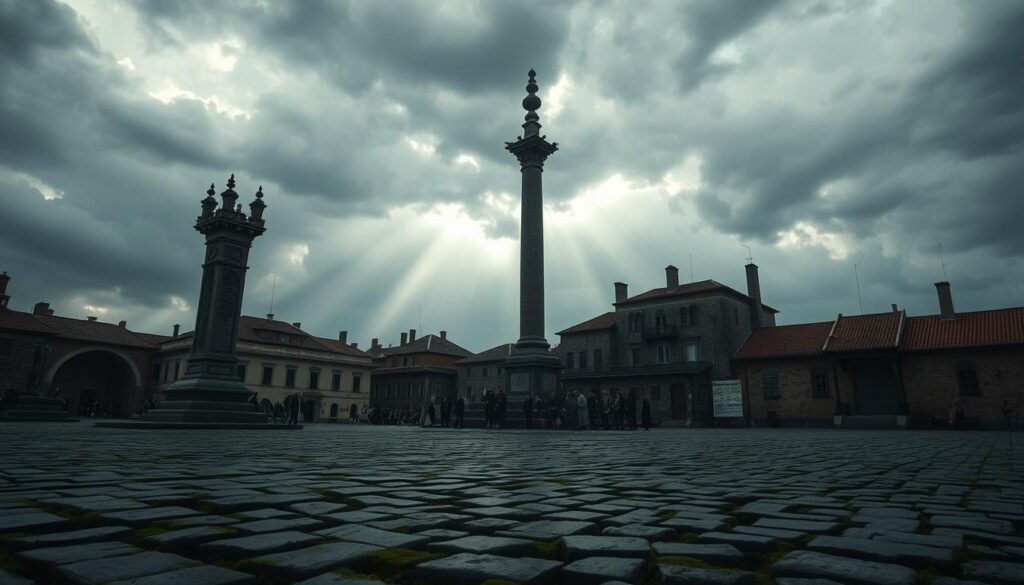
Across many European squares I noticed tall columns that began as public thanks after severe outbreaks. These vertical monuments, often called Marian or Holy Trinity columns, celebrate deliverance and communal survival.
What they are: unlike market crosses, these columns are typically baroque, decorative, and erected after the worst had passed. They often show the Virgin or the Trinity in relief and can include inscriptions that reference the Black Death or later years of crisis.
How to read them in the field
Squares and churchyards hosted these columns as civic focal points. The pillar in Košice, Slovakia is a clear example of a city memorial that reshaped public ritual and identity.
Note that a nearby basin or headless base may belong to an earlier exchange point or a vinegar stone, such as Wentworth’s. Auxiliary crosses and small stones can mark layered use of the same point over centuries.
- Tip: look for dedicatory plaques that name years or victims to separate thanksgiving monuments from sites where people died.
- Compare form and function: columns commemorate deliverance; trough stones usually served active exchange.
Reading the stones: language, symbols, and religious motifs
Stone inscriptions often speak louder than archives when you stand beside a worn base or a carved face. I read wording, iconography, and placement together to limit guesswork and to weigh function against devotion.
Cross forms and typologies
Simple shafts with socketed bases often mark a civic point for trade or warning. A headless stump can signal age or reuse. An elaborated calvary form tends to be devotional and later in the period.
Language, invocations, and dating
I look for short pleas and saintly dedications. Door texts like the quoted phrase below signal urgency and household notice.
“Lord, have mercy upon us”
Dates matter. An inscription naming the Black Death era points to fourteenth-century memory. Seventeenth-century dates usually reflect regulatory responses to later outbreaks.
Iconography, wear, and layered reading
Marian monograms on a column suggest thanksgiving and spiritual protection rather than an exchange point. Coin-scored lips or basin wear strengthen a transactional reading.
Warning: plaques sometimes mix sacramentals, like the Plague Cross of Saint Zacharias, with civic language. I always cross-check wording with siting to reduce interpretive risk.
Who the victims were: insights from bioarchaeology and risk
Skeletons and chemical traces in teeth and bone help me see who faced the greatest risk during outbreaks. These data show uneven outcomes across age, sex, and social position.
Sex, age, and prior stressors shaping mortality
Analysis from London burials links higher mortality to males and to individuals with prior stress markers such as healed fractures or enamel hypoplasia.
Older adults also carried greater risk in many events. Sex patterns varied by place and century, so no single rule fits every town.
Dietary patterns and protein access
Stable isotopes reveal long-term diets. People with protein-rich diets tended to survive famine and epidemic years more often.
This does not reflect acute infection but years of better nutrition that improved resilience.
| Factor | Bioarchaeological signal | Implication for risk |
|---|---|---|
| Prior stress | Enamel hypoplasia, porotic lesions | Higher chance to have died during outbreak |
| Age and sex | Adult ages concentrated; male bias in some sites | Older adults higher risk; sex varies by region |
| Diet | High nitrogen isotopes imply protein access | Linked to better survival in Black Death and later epidemics |
I argue that reading stones and cemetery records together helps reveal who died plague and why. In small Italian towns, occupation, parish ties, and diet likely shaped which individuals used exchange points and which avoided them.
Medieval plague markers in urban peripheries versus rural areas
My field notes show that urban peripheries organized a ring of exchange points while rural lanes kept a few dispersed junction crosses.
City-edge logic: towns like York set trading crosses about a mile outside the gate in 1604. That placement kept flows of grain and fuel moving without forcing the wider population into the urban core after the Black Death era.
Market edges, routes, and boundary points as risk management
I found that cities favored standardized points on approach roads and market edges. These locations handled high volumes of goods and individuals while limiting direct contact inside the city.
Rural areas often used junction crosses near bridges, fords, or toll points. Greenway Cross at Macclesfield shows this pattern in 1603 and 1646.
- Scale differences: villages usually kept one key cross; towns issued rings of points.
- Dual roles: many boundary points coincided with parish limits, serving civic and religious needs across the period.
- How to test reuse: check municipal ledgers, parish books, and dateable inscriptions to separate original wayside crosses from later plague associations.
| Location type | Common siting | Function cue |
|---|---|---|
| City periphery | Approach roads; market edge | Multiple points; basins or worn bases |
| Rural junction | Bridges, fords, tolls | Single cross; parish mentions |
Field guide: how I identify authentic plague markers on the ground
I start fieldwork with material close-up: fabric, tool marks, and basin polish give the clearest clues. I touch the stone surface to note limestone softness or granite resistance. A chiselled trough with smooth wear often signals repeated handling for coins or ladles.
Stone types and bases
Stone types, troughs, and wear patterns
I compare socketed bases and stepped plinths to roadside crucifixes. Socket stones and worn lips point to a transactional use. If a basin shows concentric polishing, I record dimensions and depth.
Siting clues near markets, parish boundaries, and roads
I map each feature relative to market squares, gates, and parish lines. Proximity to a historic market or gate strengthens a hypothesis that the point handled trade during outbreaks or other time of crisis.
Documenting inscriptions, dates, and local oral histories
I photograph inscriptions, log GPS coordinates, and sketch basins. Then I cross-check municipal ledgers, bishop’s visitation records, and oral accounts from older individuals. Comparing two or three crosses in one town often shows clear differences: a basin near the market and a memorial near the churchyard.
| Test | Field cue | Interpretation |
|---|---|---|
| Fabric | Limestone softness vs. granite resilience | Weathering rate; basin polish indicates use |
| Base form | Socketed plinth or stepped plinth | Market-era masonry vs. devotional reuse |
| Siting | Near gate, square, or parish boundary | Risk-management point vs. memorial |
| Records | Ledger dates; visitation notes; oral names | Aligns inscription dates with known outbreaks |
Preservation and ethical visiting of plague sites today
I approach memorial sites with rules that balance study and respect for living traditions. These places often honor people who died in past outbreaks, and they deserve quiet attention and care.
Respecting memorial contexts and community practices
I urge visitors to treat active memorial sites as places of mourning, not props. Follow parish and municipal guidelines posted on site.
A few basic courtesies:
- Avoid touching fragile stones or climbing plinths; photograph rather than place objects in basins.
- Do not interfere with offerings or processions; many people still use crosses and memorials for prayer.
- Be mindful that some memorials, like Ross-on-Wye’s Corpse Cross, are treated as local monuments and receive offerings.
Working with local archives and municipal records
Ask for finding aids and request permission for close measurements or rubbings; many sites are protected. Cite records precisely and share your notes with local historians when possible.
“Visitors should respect ongoing rituals and seek guidance from custodians.”
Ethical documentation also means protecting individuals’ privacy when recent burials sit near older memorials. Prioritize community wishes and conservation status over research impulses.
Medieval plague markers
I synthesise how door notices, market basins, memorial crosses, and devotional sacramentals form a single vocabulary of response.
Precision matters. The term covers at least four forms: painted door signs that warned neighbors, carved stones with basins used for exchanges, dedicatory crosses that record loss, and devotional shafts used for protection or prayer.
Quick checklist to tell function from form
- Form: basins, worn lips, or coin scoring point to exchange use.
- Siting: placement by a gate or market favors transactional function.
- Inscription: names and dates usually indicate memorial purpose; short household pleas often mark quarantine.
- Context: parish notes or municipal entries corroborate intended use across periods.
Language on plaques can mislead. A later plaque may call a reused cross a “plague cross” even if the stone began life as a market post. I always corroborate wording with form, siting, and records before assigning a function.
“Corroborate word with stone and site; do not accept a single label as proof.”
How this article helps: my framework slots any newly found cross or stone into a coherent typology without oversimplifying. It lets you assess whether a feature warned people, regulated exchange, memorialized victims, or offered protection to individuals and communities.
| Feature | Likely function | Field cue |
|---|---|---|
| Door sign | Warning / quarantine | Paint traces; proximity to houses; household pleas |
| Stone with basin | Exchange / disinfection | Polished lip; basin depth; market-edge siting |
| Dedicated cross | Memorial / devotional | Inscriptions with dates; churchyard placement |
Planning an itinerary: small Italian towns that keep the memory alive
I map a short travel route that pairs on-site inspection with quick archive checks. This approach helps you see how a single city managed trade, worship, and notice across years of outbreaks.
Lombardy route and parallels in Piedmont and Veneto
Start in Brugherio to visit the three plague crosses at Piazza Roma, Viale Lombardia, and Torazza. These sites tie to 1576 open-air altars and show coordinated civic response.
I then suggest short stops at nearby parishes to compare churchyard inscriptions where some individuals are named as having died plague, and at roadside wayside crosses in Piedmont. Veneto towns often keep memorial stones dated to specific years.
- Archive tip: consult municipal ledgers between visits for repair notes or relocations.
- Timing: visit markets early morning and churches mid-afternoon for quiet access.
- Compare: use York’s trading crosses and Derby’s vinegar stone as functional benchmarks when reading basins, siting, and inscriptions.
“Note where lists of names cluster in churchyards; exchange stones sit near market edges.”
Conclusion
To sum up, I show how careful attention to form, siting, and inscription lets anyone interpret signs in small Italian towns with confidence.
I argue that the Black Death set a template: houses, exchange stones, and devotional crosses first met immediate need. Later times refined those features into more specialized market devices and memorials.
Individuals and whole populations left traces not only in archives but on stone—bases worn by hands, basins polished by trade, and short dedications that name years or hope.
I invite you to use this article as a living field companion. Share responsibly documented finds with local custodians and archives so community knowledge grows.
Take time on site: circle a base, trace street lines, check dates. These small acts repay you with clearer insight into a crisis period and human resilience.